



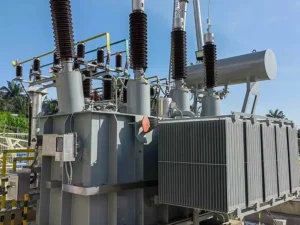
How to Correctly Select Transformer Capacity
Selecting the correct transformer capacity is critical to ensure safe operation, high efficiency, and long service life. An undersized transformer may overload and fail prematurely, while an oversized transformer increases unnecessary investment and operating costs. Transformer Capacity Calculation Step 1: Select Rated Voltage This ensures adequate voltage under load conditions. Step 2: Determine Rated Capacity The rated capacity should be selected based on the maximum combined load: Other nameplate parameters should be considered according to the transformer product specifications. Example Calculation Select a 35/10 kV transformer: Capacity calculation:S=0.7×35000.8=3062 kVAS = 0.7 \times \frac{3500}{0.8} = 3062 \text{ kVA}S=0.7×0.83500=3062 kVA Recommended selection: Then select the appropriate transformer model from the product catalog. Transformer Capacity Calculation Formula Step 1: Calculate Maximum Power per Phase Sum the load power for each phase independently: Select the maximum phase load: 11 kW Notes: Example: Total phase C load:(0.3×10)+(2×4)=11 kW(0.3 \times 10) + (2 \times 4) = 11 \text{ kW}(0.3×10)+(2×4)=11 kW Step 2: Calculate Total Three-Phase Power 11 kW×3=33 kW11 \text{ kW} \times 3 = 33 \text{ kW}11 kW×3=33 kW Step 3: Calculate Transformer Input Power Most transformers on the market have a power factor of approximately 0.8, so this step is critical:330.8=41.25 kW\frac{33}{0.8} = 41.25 \text{ kW}0.833=41.25 kW Step 4: Calculate Required Transformer Capacity According to