
Dry-type transformers are widely used in applications such as local lighting, high-rise buildings, airports, docks, and CNC machinery. In simple terms, a dry-type transformer refers to a transformer whose core and windings are not immersed in insulating oil.
Cooling methods include Natural Air Cooling (AN) and Forced Air Cooling (AF).
Under natural air cooling, the transformer can operate continuously at rated capacity.
Under forced-air cooling, the output capacity can be increased by up to 50%.
Dry-type transformers are suitable for intermittent overload operation or emergency overload situations; however, long-term continuous overload is not recommended, as load losses and impedance voltage increase significantly under overload, resulting in non-economic operation.
Table of Contents
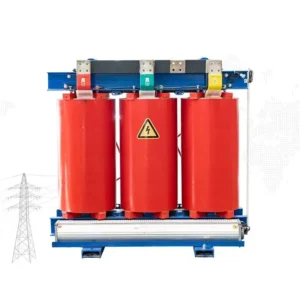
1. Structural Types
Construction Features
-
Solid-Insulated Encapsulated Windings
-
Non-Encapsulated Windings
Among the windings, the one with the higher voltage is the high-voltage winding, and the one with the lower voltage is the low-voltage winding.
From the relative positioning of the windings, the high-voltage designs can be categorized into:
-
Concentric Type – simple and easy to manufacture; widely used.
-
Interleaved Type – mainly used for special-purpose transformers.
2. Structural Characteristics
-
Safe, fire-resistant, pollution-free, and suitable for installation close to load centers.
-
Manufactured with advanced domestic technology, offering high mechanical strength, strong short-circuit resistance, low partial discharge, excellent thermal stability, high reliability, and long service life.
-
Low losses, low noise, energy-saving, and maintenance-free.
-
Excellent heat dissipation, strong overload capability, and increased capacity under forced-air cooling.
-
Superior moisture resistance, suitable for high humidity and harsh environments.
-
Can be equipped with a complete temperature monitoring and protection system. The intelligent temperature control system automatically detects and displays the operating temperature of each phase, starts/stops fans automatically, and includes alarm and trip protection functions.
-
Compact size, lightweight, small footprint, and low installation cost.
3. Core and Winding Structure
Iron Core
Made of high-quality cold-rolled grain-oriented silicon steel sheets.
The laminations are cut at 45° mitered joints, allowing magnetic flux to pass smoothly along the seam direction.
Winding Types
-
Wound-type construction
-
Epoxy resin casting with quartz sand filler
-
Glass-fiber–reinforced epoxy resin cast (thin-insulation structure)
-
Multi-strand fiberglass immersed in epoxy resin (widely used due to its crack-resistant structure and higher reliability)
High-Voltage Windings
Typically designed in multi-layer cylindrical or multi-section segmented structures.
4. Transformer Forms
-
Open Type
The core and windings are directly exposed to the atmosphere. Suitable for clean, dry indoor environments (relative humidity ≤85% at 20°C). Cooling methods include natural air cooling and forced-air cooling. -
Enclosed Type
The core and windings are placed in a sealed housing, isolated from the atmosphere. Due to limited heat dissipation, this type is mainly used in mining applications and classified as explosion-proof. -
Cast Resin Type
The main insulation is made by casting epoxy or similar resins. Simple structure, small size, ideal for small-capacity transformers.
5. Technical Parameters
-
Frequency: 50/60Hz
-
No-load current: <4%
-
Dielectric strength: 2000V/min without breakdown (Instrument: YZ1802 withstand voltage tester, 20mA)
-
Insulation class: Class F (customizable)
-
Insulation resistance: ≥2MΩ (Instrument: ZC25B-4 Megohmmeter <1000V)
-
Connection methods: Y/Y, △/Y0, Y0/△, or autotransformer type
-
Allowable temperature rise: 100K
-
Cooling method: Natural air or intelligent temperature-controlled air cooling
-
Noise level: ≤30dB
6. Operating Environment Requirements
-
Temperature: -10°C to +40°C; relative humidity <70%
-
Altitude: ≤2500 meters
-
Avoid rain, moisture, high heat, or direct sunlight. Maintain at least 1,000px clearance around ventilation openings.
-
Do not operate in environments with corrosive liquids, gases, excessive dust, conductive fibers, or metallic particles.
-
Avoid vibration or electromagnetic interference.
-
Do not store or transport the transformer upside down; avoid severe impact or shock.
| Model | Phase / Number of Phases | Dimensions (mm) | Weight (kg) | ||
|---|---|---|---|---|---|
| Length | Width | Height | |||
| BGS-3 | 3 | 350 | 280 | 380 | 30 |
| BGS-6 | 3 | 400 | 280 | 400 | 35 |
| BGS-10 | 3 | 400 | 280 | 400 | 50 |
| BGS-15 | 3 | 450 | 300 | 450 | 65 |
| BGS-20 | 3 | 450 | 300 | 450 | 85 |
| BGS-25 | 3 | 450 | 350 | 450 | 90 |
| BGS-30 | 3 | 450 | 350 | 450 | 110 |
| BGS-35 | 3 | 550 | 360 | 550 | 120 |
| BGS-40 | 3 | 550 | 360 | 550 | 130 |
| BGS-45 | 3 | 550 | 400 | 550 | 140 |
| BGS-50 | 3 | 550 | 400 | 550 | 150 |
| BGS-60 | 3 | 600 | 450 | 660 | 175 |
6. Product Selection
Product Definition
Distribution transformers are essential equipment in the power supply systems of industrial, mining, and civil buildings. They step down 10(6) kV or 35 kV grid voltage to the 230/400 V bus voltage used by end-users.
These transformers are suitable for AC 50/60 Hz, with a maximum three-phase rated capacity of 2500 kVA (maximum single-phase rated capacity of 833 kVA; single-phase transformers are generally not recommended).
-
When there is a significant amount of primary or secondary load, it is recommended to install two or more transformers. If any one transformer is disconnected, the remaining transformers must still be capable of supplying the primary and secondary loads. Primary and secondary loads should be concentrated rather than widely dispersed.
-
For locations with substantial seasonal load variations, special-purpose transformers should be installed — for example, air-conditioning chillers and heating loads in large commercial buildings.
-
For locations with highly concentrated loads, special-purpose transformers should be installed — such as large heating equipment, large X-ray machines, and electric arc furnaces.
-
When lighting load is large or when combined power-lighting supply adversely affects lighting quality and lamp lifespan, a dedicated lighting transformer may be installed. Generally, power and lighting share the same transformer.
Selecting Transformers Based on Environmental Conditions
-
Under normal environmental conditions, either oil-immersed or dry-type transformers may be selected — such as in industrial/mining plants, agricultural substations, or standalone community substations. Common models include S8, S9, S10, SC(B)9, SC(B)10, etc.
-
For multi-story or high-rise buildings, non-flammable or flame-retardant transformers are preferred, such as SC(B)9, SC(B)10, SCZ(B)9, SCZ(B)10.
-
In environments with heavy dust or corrosive gases that may endanger transformer safety, sealed or enclosed transformers should be used — such as BS9, S9-, S10-, SH12-M.
-
High- and low-voltage equipment without flammable oil and non-oil-immersed transformers may be installed in the same room. In such cases, the transformer must be equipped with an IP2X protective enclosure for safety.
Selecting Transformers Based on Load Requirements
-
The capacity of the distribution transformer should be determined by evaluating the installed capacities of all electrical equipment and calculating the required load (fire-fighting loads are generally excluded). The compensated apparent power is used to determine transformer capacity and quantity. A typical transformer load rate is about 85%. This method is convenient and suitable for preliminary capacity estimation.
-
According to GB/T 17468-1998 Guidelines for Selection of Power Transformers, the capacity of distribution transformers should be determined based on GB/T 17211-1998 Dry-Type Power Transformer Loading Guide and the calculated load. These guidelines provide computer programs and standard load cycle charts for precise transformer capacity selection.
7. Installation Requirements
Distribution transformers are key components of substations.
Dry-type transformers without enclosures can be installed directly on the floor with protective barriers around them; dry-type transformers with enclosures can also be floor-mounted.
Installation should follow the national architectural standard design atlas: 03D201-4 – 10/0.4 kV Transformer Room Layout and Common Equipment Installation.
8. Model Selection
Temperature Control System
The safe operation and service life of dry-type transformers largely depend on the reliability of the insulation of their windings. If winding temperature exceeds the insulation limit, insulation failure may occur — one of the primary causes of transformer malfunction. Therefore, temperature monitoring and over-temperature protection are critical.
-
Automatic Fan Control
Temperature is measured by Pt100 thermal sensors embedded at the hottest spot of the low-voltage winding.-
When winding temperature reaches 110°C, the cooling fans start automatically.
-
When temperature drops to 90°C, the fans stop automatically.
-
-
Over-temperature Alarm and Trip Protection
PTC thermistors embedded in the low-voltage winding collect winding or core temperature signals.-
At 155°C → Over-temperature alarm output
-
At 170°C → Over-temperature trip signal sent to the secondary protection circuit; transformer must shut down immediately.
-
-
Temperature Display System
Pt100 sensors measure temperature and display the winding temperatures of all phases (with phase scanning and max-value indication).
It can record historical maximum temperature and output a 4–20 mA signal for remote monitoring (up to 1200 m).
Protection Method
IP20 enclosures are commonly used, preventing solid objects larger than 12 mm and small animals (mice, snakes, cats, birds) from entering and causing short-circuits.
For outdoor installation, IP23 enclosures may be used, providing additional protection against water falling at angles up to 60°.
Note: IP23 enclosures reduce cooling efficiency, so derating must be considered.
Overload Capability
The overload capability of dry-type transformers depends on ambient temperature, load level before overload, insulation cooling efficiency, and thermal time constant. Manufacturers may provide overload curves when needed.
How to utilize overload capability:
-
Transformer capacity may be appropriately reduced during selection if equipment such as rolling mills and welding machines produce short-term overloads — taking advantage of the strong overload capability of dry-type transformers.
-
For areas with uneven load distribution, such as residential zones (night lighting), entertainment facilities, shopping malls (daytime air-conditioning and lighting), transformer capacity may be reduced appropriately so that the transformer operates at or close to full load for most of its duty cycle.
9. Inspection Checklist
-
Check for abnormal noise or vibration.
-
Check for local overheating, corrosion, discharge marks, or carbonization on insulation surfaces.
-
Ensure the cooling fans are operating normally.
-
High- and low-voltage terminals must have no overheating; cable terminals should have no leakage or tracking.
-
Temperature rise of windings must not exceed the limit specified by the insulation class.
-
Supporting porcelain parts must have no cracks or discharge traces.
-
Verify that winding compression components are not loose.
-
Ensure indoor ventilation and that the core air ducts are clean, without dust blockage, rust, or corrosion.
10. Differences
-
Frequency Converter (VFD):
Adjusts output frequency (50 Hz, 60 Hz, etc.) to meet specific electrical requirements. -
Transformer:
Generally functions as a “step-down device” commonly found near residential areas or factories. Its purpose is to reduce high transmission voltage to the voltage used in daily electrical systems. -
Dry-Type vs Oil-Immersed Transformers:
Dry-type transformers offer better fire safety and are used in areas with strict fire-protection requirements — such as hospitals, airports, and railway stations.
However, they are more expensive and require suitable environments (not excessively humid, dusty, or contaminated).