





Selecting the correct transformer capacity is critical to ensure safe operation, high efficiency, and long service life. An undersized transformer may overload and fail prematurely, while an oversized transformer increases unnecessary investment and operating costs.
Transformer Capacity Calculation
Step 1: Select Rated Voltage
- High-voltage side: Must match the grid voltage.
- Low-voltage side: Typically selected 5% or 10% higher than the low-voltage grid voltage, depending on:
- Transformer voltage class
- Impedance voltage
This ensures adequate voltage under load conditions.
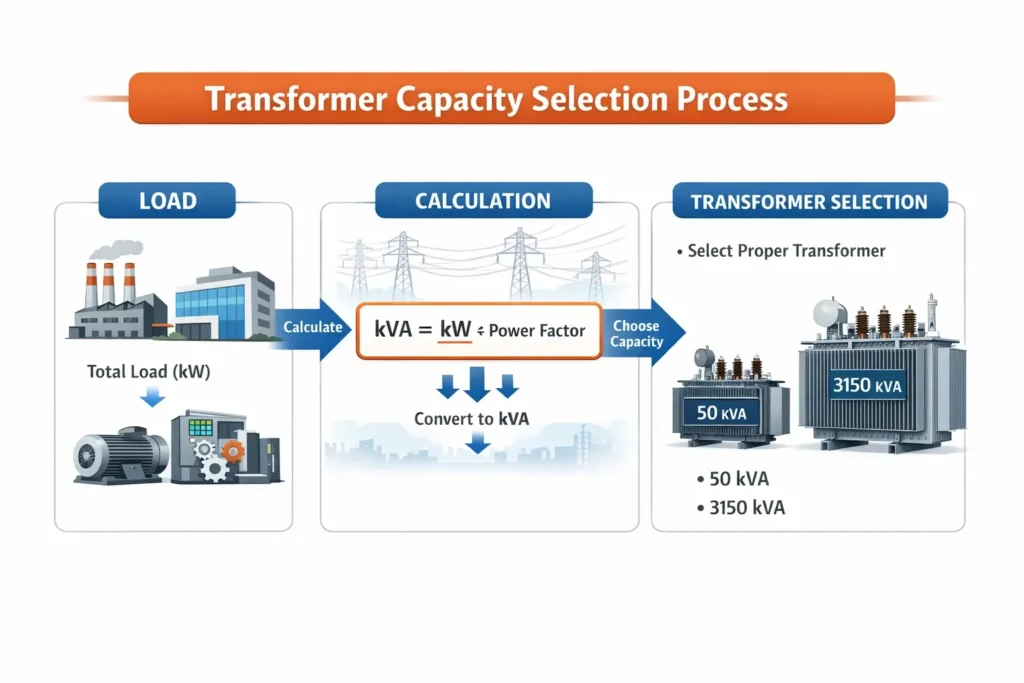
Step 2: Determine Rated Capacity
The rated capacity should be selected based on the maximum combined load:
- Calculate the maximum active load (kW).
- Convert active power (kW) to apparent power (kVA).
- If two transformers are used:
- Each transformer can be selected at 70% of the maximum combined load.
- If one transformer is used:
- Capacity should cover the total load with sufficient margin.
Other nameplate parameters should be considered according to the transformer product specifications.
Example Calculation
Select a 35/10 kV transformer:
- Maximum load: 3500 kW
- Power factor: 0.8
- Number of transformers: 2
Capacity calculation:S=0.7×0.83500=3062 kVA
Recommended selection:
- Transformer capacity: 3150 kVA
- Voltage ratio: 35 kV / 10.5 kV
Then select the appropriate transformer model from the product catalog.
Transformer Capacity Calculation Formula
Step 1: Calculate Maximum Power per Phase
Sum the load power for each phase independently:
- Phase A: 10 kW
- Phase B: 9 kW
- Phase C: 11 kW
Select the maximum phase load: 11 kW
Notes:
- Single-phase equipment: Use the maximum rated power from the nameplate.
- Three-phase equipment: Divide total power by 3 to obtain per-phase power.
Example:
- Computers: 300 W × 10 units
- Air conditioners: 2 kW × 4 units
Total phase C load:(0.3×10)+(2×4)=11 kW
Step 2: Calculate Total Three-Phase Power
11 kW×3=33 kW
Step 3: Calculate Transformer Input Power
Most transformers on the market have a power factor of approximately 0.8, so this step is critical:0.833=41.25 kW
Step 4: Calculate Required Transformer Capacity
According to the Power Engineering Design Manual, the transformer load factor is generally selected at 85% for steady loads:0.8541.25=48.53 kVA
Final selection:
Choose a 50 kVA transformer.
3. Key Points About Transformer Rated Capacity
- Transformer rated capacity is the maximum apparent power (kVA) that ensures normal operation under specified conditions.
- This apparent power is the maximum load the transformer can supply safely.
- At rated operation, output apparent power equals rated capacity.
- Input apparent power is slightly higher than rated capacity due to losses.
- Because transformer efficiency is very high, input apparent power is often approximated as equal to rated capacity, and this assumption is acceptable in engineering practice.
- As long as the output voltage, current, power factor, and apparent power are equal to or lower than rated capacity, operation is safe (under proper conditions).
- The belief that transformers must operate below 90% of rated capacity due to losses is incorrect.
- Applying a safety margin during capacity selection based on calculated load is correct and recommended.
4. Summary
Transformer capacity calculation is not complicated, but attention must be paid to:
- Load calculation accuracy
- Power factor consideration
- Reasonable safety margins
Correct transformer capacity selection ensures:
- Safe and stable operation
- Optimal efficiency
- Reduced energy losses
- Longer transformer service life