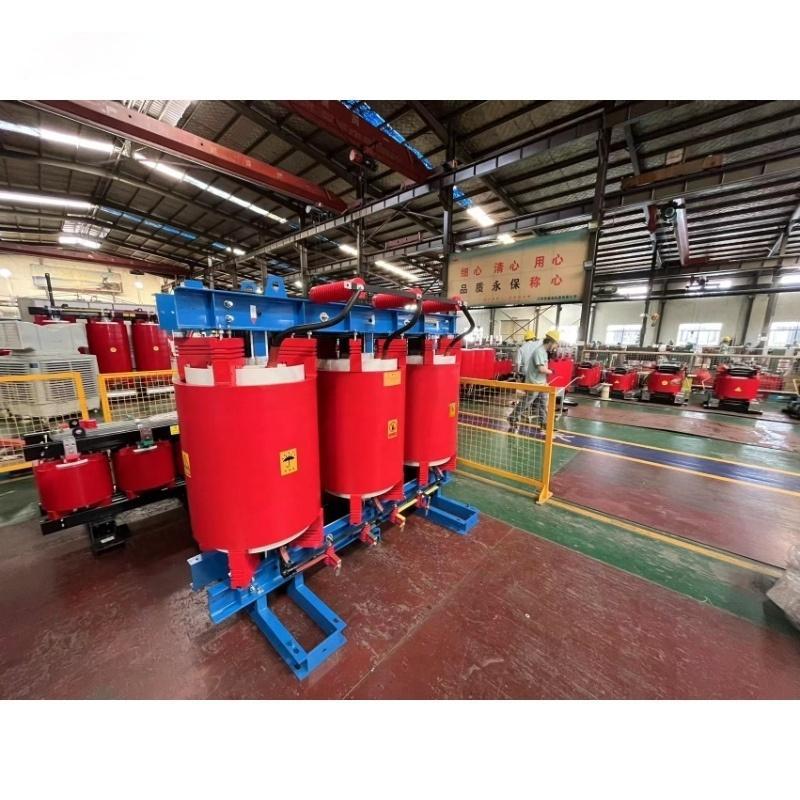




With the rapid development of the global economy, dry-type transformers have experienced significant growth worldwide. In the field of distribution transformers in particular, the market share of dry-type units has been increasing year by year. In many countries, dry-type transformers now account for 40–50% of all distribution transformers.
Table of Contents
Structural Features of Dry-Type Transformers
- Safe, fire-resistant, and environmentally friendly, allowing installation and operation directly at load centers.
- Manufactured with advanced domestic technology, offering high mechanical strength, strong short-circuit resistance, low partial discharge, excellent thermal stability, high reliability, and long service life.
- Low loss, low noise, and significant energy-saving performance, with no need for maintenance.
- Excellent heat dissipation and strong overload capacity; capacity can be increased under forced-air cooling conditions.
- Superior moisture resistance, suitable for high-humidity or harsh environmental conditions.
- Can be equipped with a comprehensive temperature monitoring and protection system. The intelligent temperature control unit automatically detects and cyclically displays the operating temperature of each phase winding, and can automatically start/stop cooling fans while providing alarm and trip functions.
- Compact size, lightweight design, minimal footprint, and low installation cost.
Structural Designs
-
Open Type
A common structure where the transformer body is in direct contact with the atmosphere. Suitable for clean and relatively dry indoor environments (relative humidity ≤ 85% at 20°C). Cooling methods include natural air cooling and forced-air cooling. -
Enclosed Type
The transformer body is housed in a sealed enclosure and does not come into direct contact with the atmosphere. Due to poorer sealing and heat dissipation conditions, this type is mainly used in mining applications as an explosion-proof transformer. -
Cast-Resin Type
Epoxy resin or other resin materials are used for the main insulation. This structure is simple, compact, and typically used for small-capacity transformers.
Cooling Methods
Dry-type transformers are cooled using either natural air cooling (AN) or forced-air cooling (AF).
Under natural air cooling, the transformer can operate continuously at its rated capacity. With forced-air cooling, the output capacity may be increased by up to 50%, making it suitable for intermittent overload or emergency overload conditions.
However, due to increased load losses and higher impedance voltage under overload, the transformer enters a non-economic operating state. Therefore, continuous long-term overload operation is not recommended.
Product Selection Guidelines
1. Selecting Transformers Based on Load Characteristics
-
When there is a large amount of first- or second-class load, two or more transformers should be installed. If one transformer is disconnected, the remaining units must still be able to supply all Level 1 and Level 2 loads. These important loads should be concentrated as much as possible instead of being scattered.
-
For large seasonal loads, dedicated transformers are recommended, such as air-conditioning chillers or electric heating loads in large commercial buildings.
-
For large concentrated loads, dedicated transformers should also be installed, such as large heating equipment, large X-ray machines, or electric arc furnaces.
2. Environmental and Structural Considerations
-
Under normal environmental conditions, either oil-immersed or dry-type transformers may be selected—for example, in industrial plants, agricultural power stations, or standalone substation rooms within residential communities.
-
In multi-story or high-rise buildings, non-flammable or flame-retardant transformers should be used.
-
In dusty or corrosive environments, enclosed or sealed transformers are required to ensure safe operation.
-
High- and low-voltage equipment without flammable oil and non–oil-immersed distribution transformers may be installed in the same room. In such cases, transformers should be equipped with an IP2X protective enclosure for safety.
Installation Notes
Distribution transformers are key components of substations.
-
Dry-type transformers without enclosures are directly installed on the ground and protected by safety barriers.
-
Dry-type transformers with enclosures can also be directly installed on the ground without additional protective structures.
Applications of Dry-Type Transformers
Since dry-type transformers contain no oil, they eliminate risks such as fire, explosion, and pollution. As a result, they do not require installation in a dedicated transformer room, enabling both transformers and other electrical equipment to be installed in the same room.
Comparison Between Dry-Type and Oil-Immersed Transformers
Dry-type and oil-immersed transformers are the two most widely used transformer types. Compared with oil-immersed transformers, dry-type transformers offer superior fire safety, making them suitable for locations with strict fire protection requirements such as hospitals, airports, and railway stations.
However, dry-type transformers are generally more expensive and have certain environmental requirements—for example, they should not be installed in overly humid, dusty, or heavily polluted environments.