





Box-type substations will play a vital role in improving power grid reliability and modernization, pushing electrical infrastructure to a higher level.
Table of Contents
Overview of Box-Type Substations
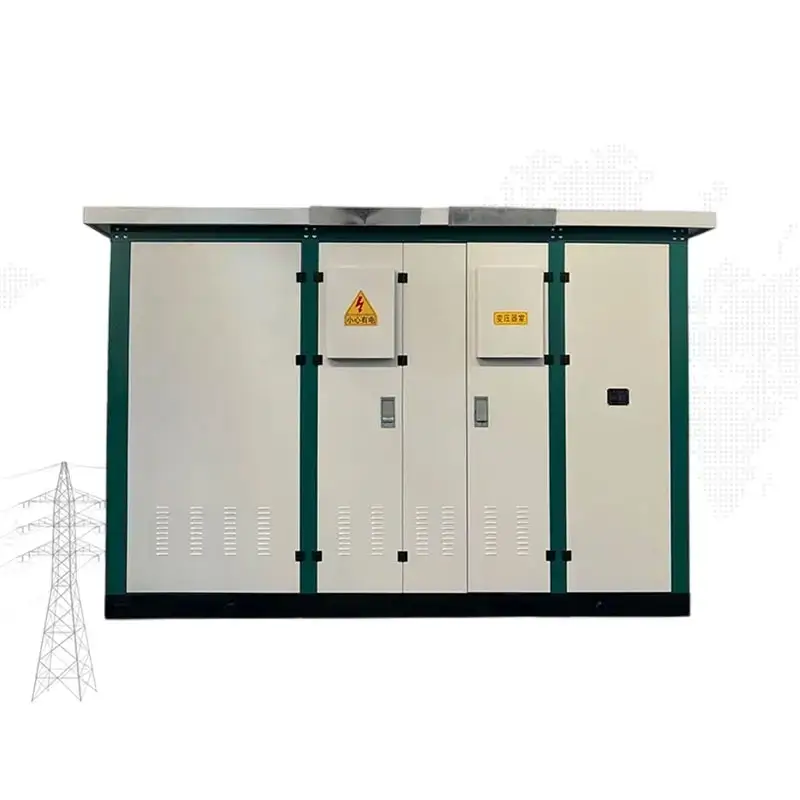
A box-type substation (commonly referred to as a package substation) is a compact, integrated power distribution system that combines:
- High-voltage switchgear
- Distribution transformer
- Low-voltage switchgear
- Metering equipment
- Reactive power compensation devices
These components are assembled according to a predefined wiring scheme and installed within one or more enclosed metal housings.
Box-type substations are widely used in 10 kV / 0.4 kV three-phase AC systems, serving as equipment for power reception, transformation, and distribution.
Also known as prefabricated substations, box-type substations are factory-assembled, compact units suitable for indoor and outdoor installation. They integrate voltage transformation and low-voltage distribution into a fully enclosed steel structure that is:
- Moisture-proof
- Rust-proof
- Dust-proof
- Rodent-proof
- Fire-resistant
- Theft-resistant
- Thermally insulated
- Movable
They are especially suitable for urban power grid construction and upgrading, representing a modern alternative to traditional civil-built substations.
Typical applications include:
- Mines
- Industrial plants
- Oil and gas fields
- Wind power stations
Box-type substations replace traditional masonry-built distribution rooms and substations, becoming a new-generation integrated power distribution solution.
Classification of Box-Type Substations
Differences Between American-Type and European-Type Designs
Box-type substations are mainly classified into:
- American-type box substations (combined type)
- European-type box substations (prefabricated type)
2.1 Concepts: Modular, European-Type, and American-Type
(1) Modular (Assembled) Substation
This type installs high-voltage equipment, low-voltage switchgear, and transformers into a metal enclosure, with an internal operating corridor between HV and LV sections.
Due to its large size, this design is now rarely used.
(2) Combined Device Substation (European-Type Box Substation)
In this design, high- and low-voltage devices are not traditional switchgear panels. Instead, control and protection devices are directly integrated into the enclosure.
Key features:
- Maintenance-free design
- No internal operating corridor
- Compact structure
This is the most widely used European-type box substation today.
(3) Integrated Substation (American-Type Box Substation)
The American-type box substation integrates:
- High-voltage components
- Low-voltage components
- Transformer
All within a single transformer oil tank, forming a highly compact unit.
Advantages:
- Extremely compact size
- Volume comparable to a standard oil-immersed transformer of the same capacity
- Only about one-third the size of a European-type box substation
2.2 Key Differences Between American-Type and European-Type Box Substations
High-Voltage Protection Design
- American-type box substation
- High-voltage protection:
- Plug-in fuse
- Backup fuse + load break switch
- Only two HV wiring schemes:
- Ring network (dual power supply)
- Terminal supply
- High-voltage protection:
- European-type box substation
- High-voltage protection options:
- Air-insulated load switch
- Vacuum load switch
- SF₆ load switch + fuse
- Protection configuration selected based on switching frequency
- More flexible capacity and configuration
- High-voltage protection options:
Structural Flexibility
The biggest difference lies in the high-voltage section:
- European-type substations use independent functional units, allowing:
- Customized HV, transformer, and LV compartments
- Greater flexibility for automation and expansion
- American-type substations are:
- More compact
- Less flexible
- Significantly lower in cost
2.3 Features of American-Type Box Substations
Advantages
- Small footprint
- Easy installation and concealment
- Better environmental integration in residential areas
- Shorter low-voltage cable length
- Reduced line losses
- Lower overall project cost
Disadvantages
- Lower power supply reliability
- No motorized mechanisms
- Difficult to implement distribution automation
- No built-in capacitor banks (higher line losses)
- Limited expansion capability
- Capacity upgrades require civil reconstruction and long outages
Typical Applications
American-type box substations are suitable for:
- Low-rise residential buildings
- Non-critical power consumers
When combined with small ring main units, they can meet multi-story residential power demands, but are not suitable for mid-rise or high-rise buildings.
2.4 Features of European-Type Box Substations
Advantages
- Lower electromagnetic radiation
- Transformer enclosed in metal housing (shielding effect)
- Supports distribution automation
- Retains most advantages of American-type substations
Disadvantages
- Larger size
- Higher installation and layout requirements
Typical Applications
European-type box substations are ideal for:
- Multi-story residential buildings
- Mid-rise and high-rise buildings
- Critical power supply facilities
3. Development Prospects of Box-Type Substations
Box-type substations are a key direction for rural grid upgrades and future substation construction, but some limitations remain:
(1) Fire Protection Challenges
Although modern box substations are:
- Fully enclosed
- Unattended
- Oil-free
- Equipped with remote smoke detection
Fire risks still exist due to:
- Cables
- Capacitor banks
Poor ventilation complicates firefighting.
Installing automatic fire suppression systems is recommended, though it increases manufacturing cost.
(2) Capacity Expansion Limitations
Due to limited enclosure space:
- Outgoing feeder expansion is difficult
- Adding 1–2 additional feeders often requires a new enclosure
(3) Maintenance Constraints
Limited internal space:
- Restricts maintenance access
- Complicates emergency repairs
This is an inherent limitation of compact box-type substation design.
4. Conclusion
Despite certain limitations, box-type substations will continue to see widespread adoption across:
- Urban power grids
- Rural electrification projects
- Industrial facilities
- Public infrastructure
With advantages such as:
- Compact structure
- Cost efficiency
- Fast installation