



Product News

Blog

News

Contact US

If you are interested in cooperation, please contact us immediately, we will give you feedback as soon as possible!

How to Correctly Select Transformer Capacity

Selecting the correct transformer capacity is critical to ensure safe operation, high efficiency, and long service life. An undersized transformer may overload and fail prematurely, while an oversized transformer increases unnecessary investment and operating costs. Transformer Capacity Calculation Step 1: Select Rated Voltage This ensures adequate voltage under load conditions. Step 2: Determine Rated Capacity The rated capacity should be selected based on the maximum combined load: Other nameplate parameters should be considered according to the transformer product specifications. Example Calculation Select a 35/10 kV transformer: Capacity calculation:S=0.7×35000.8=3062 kVAS = 0.7 \times \frac{3500}{0.8} = 3062 \text{ kVA}S=0.7×0.83500​=3062 kVA Recommended selection: Then select the appropriate transformer model from the product catalog. Transformer Capacity Calculation Formula Step 1: Calculate Maximum Power per Phase Sum the load power for each phase independently: Select the maximum phase load: 11 kW Notes: Example: Total phase C load:(0.3×10)+(2×4)=11 kW(0.3 \times 10) + (2 \times 4) = 11 \text{ kW}(0.3×10)+(2×4)=11 kW Step 2: Calculate Total Three-Phase Power 11 kW×3=33 kW11 \text{ kW} \times 3 = 33 \text{ kW}11 kW×3=33 kW Step 3: Calculate Transformer Input Power Most transformers on the market have a power factor of approximately 0.8, so this step is critical:330.8=41.25 kW\frac{33}{0.8} = 41.25 \text{ kW}0.833​=41.25 kW Step 4: Calculate Required Transformer Capacity According to
Read More »

What Is a Box-Type Substation?

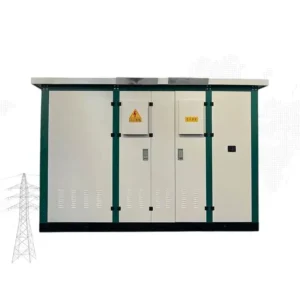
A box-type substation (also known as a prefabricated substation or package substation) is a compact, factory-assembled power distribution system that integrates: These components are arranged according to a predefined wiring scheme and enclosed within a fully sealed steel structure enclosure suitable for indoor or outdoor use. A box-type substation combines high-voltage power reception, voltage transformation, and low-voltage power distribution into a single unit. The enclosure is designed to be moisture-proof, rust-proof, dust-proof, rodent-proof, fire-resistant, theft-resistant, thermally insulated, and fully enclosed, with optional mobility. Compared with traditional civil-built substations, box-type substations feature compact structure, fast installation, and fully enclosed operation, making them a modern solution widely used in urban power distribution network construction and renovation. Application Areas of Box-Type Substations Box-type substations are widely used in: They replace traditional masonry-built distribution rooms and substations, becoming a new-generation integrated power distribution solution. Typical applications include: Typical Installation Scenarios 1. Street Lighting Power Supply Both European-type and American-type box substations offer significant advantages over traditional substations for small-load street lighting systems.They feature: 2. Parks and Residential Communities In parks and residential areas, power equipment must be aesthetic and space-saving.Box-type substations: 3. Industrial and Mining Applications Factories and mines often face: Box-type substations are

Read More »

Advantages and Disadvantages of Dry-Type Transformers vs. Oil-Immersed Transformers

Key Differences Between Dry-Type and Oil-Immersed Transformers The most fundamental difference between oil-immersed transformers and dry-type transformers lies in whether transformer oil is used. Oil-immersed transformers use insulating oil, which is a liquid and therefore has fluidity. As a result, they must be enclosed in a sealed tank filled with transformer oil, with the windings fully immersed inside. The windings are not visible from the outside. Traditionally, oil-immersed transformers are equipped with an oil conservator, although modern designs also include sealed types without conservators. Dry-type transformers, on the other hand, do not use oil. They are typically constructed without an oil tank, allowing the core and windings to be directly visible. This design eliminates the risk associated with oil leakage and fire. Cooling Method Comparison To facilitate heat dissipation, oil-immersed transformers rely on the circulation of insulating oil. Heat generated by the windings is transferred to external radiators or cooling fins, where it is dissipated into the surrounding air. Dry-type transformers do not use oil-based cooling. Heat dissipation is achieved through: The cooling fans used in dry-type transformers are similar in principle to indoor air-conditioning units. Installation Environment and Safety Due to fire safety considerations, oil-immersed transformers are usually installed

Read More »

Transformer Nameplate Interpretation

Under specified operating conditions and environmental requirements, the main technical parameters of a transformer are usually indicated on the transformer nameplate. These parameters provide essential information for selection, operation, and maintenance. They mainly include rated capacity, rated voltage and tapping range, rated frequency, winding connection group, rated performance data, and total weight. A. Rated Capacity (kVA) Rated capacity refers to the maximum apparent power that a transformer can continuously deliver under rated voltage and rated current conditions without exceeding permissible temperature rise. B. Rated Voltage (kV) Rated voltage is the operating voltage that the transformer can withstand during long-term operation.To adapt to power grid voltage fluctuations, the high-voltage side of a transformer is usually equipped with tap changers, which regulate the output voltage on the low-voltage side by adjusting the number of turns in the high-voltage winding. C. Rated Current (A) Rated current is the maximum current allowed to flow continuously through the transformer windings when operating at rated capacity. D. No-Load Loss (kW) No-load loss is the active power absorbed by the transformer when rated voltage at rated frequency is applied to one winding while the other winding remains open-circuited.It mainly depends on: E. No-Load Current (%) No-load current

Read More »
10kv Dry type transformer

How to Choose the Right Transformer

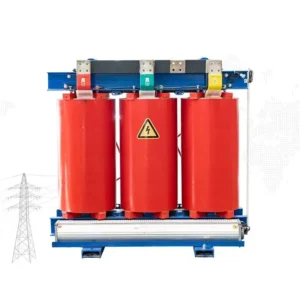
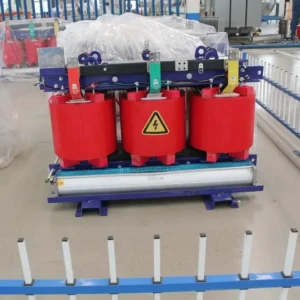
Dry-type transformers are widely used in applications such as local lighting, high-rise buildings, airports, docks, and CNC machinery. In simple terms, a dry-type transformer refers to a transformer whose core and windings are not immersed in insulating oil. Cooling methods include Natural Air Cooling (AN) and Forced Air Cooling (AF). Under natural air cooling, the transformer can operate continuously at rated capacity. Under forced-air cooling, the output capacity can be increased by up to 50%.Dry-type transformers are suitable for intermittent overload operation or emergency overload situations; however, long-term continuous overload is not recommended, as load losses and impedance voltage increase significantly under overload, resulting in non-economic operation. Table of Contents 1. Structural Types Construction Features Solid-Insulated Encapsulated Windings Non-Encapsulated Windings Among the windings, the one with the higher voltage is the high-voltage winding, and the one with the lower voltage is the low-voltage winding. From the relative positioning of the windings, the high-voltage designs can be categorized into: Concentric Type – simple and easy to manufacture; widely used. Interleaved Type – mainly used for special-purpose transformers. 2. Structural Characteristics Safe, fire-resistant, pollution-free, and suitable for installation close to load centers. Manufactured with advanced domestic technology, offering high mechanical strength, strong

Read More »

Transformer Classification Methods

Transformers come in many different types, but their working principle is always based on electromagnetic induction. The commonly used classification methods for transformers are summarized as follows: Table of Contents 1. Classification by Application ① Power Transformers Used for voltage step-up or step-down in power transmission and distribution systems; this is the most common type of transformer. ② Test Transformers Used to generate high voltage for high-voltage testing of electrical equipment. ③ Instrument Transformers Such as voltage transformers (VTs) and current transformers (CTs), used for measuring instruments and relay protection devices. ④ Special-Purpose Transformers Including furnace transformers for smelting, rectifier transformers for electrolysis, welding transformers for arc welding, and variable transformers for test and laboratory use. 2. Classification by Number of Phases ① Single-Phase Transformers. Used for single-phase loads. ② Three-Phase Transformers. Used in three-phase systems for stepping up or stepping down voltages. 3. Classification by Winding Structure ① Autotransformers: Used for ultra-high-voltage, large-capacity power systems where the voltage ratio change is relatively small. ② Two-Winding Transformers. Used for connecting two voltage levels in a power system. ③ Three-Winding Transformers. Used for connecting three voltage levels, typically applied in regional substations of power systems. 4. Classification by Core Structure ①

Read More »
Scroll to Top

Get In Touch