




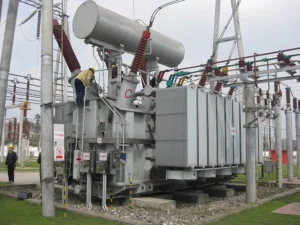
Product News

Blog

News

Contact US

If you are interested in cooperation, please contact us immediately, we will give you feedback as soon as possible!

What is a single-pole transformer substation?

Table of Contents 1. What is a single-pole transformer substation? A single-pole transformer substation is a static electromagnetic device that operates on the principle of electromagnetic induction, capable of changing voltage while maintaining the frequency of the alternating current system. This new type of compact single-pole substation is a substation where the transformer is installed on a single pole made of centrifugal concrete or a single steel pole. 2.Applications of Single-Pole Transformer Substations Single-pole transformer substations are widely used in urban and rural power distribution, industrial facilities, commercial zones, construction sites, and renewable energy projects, offering a compact, reliable, and cost-effective solution. 3. Structure of a Single-Pole Transformer Substation: Pole: Made of centrifugal concrete or steel, supporting the entire substation. Transformer: Mounted on the pole, for voltage step-up or step-down. High Voltage Equipment: Includes disconnect switch, drop-out fuse, and lightning arrester for incoming line and protection. Low Voltage Equipment: Switches, distribution box, and terminals for power distribution. Earthing System: Ensures operational and personnel safety. Accessories: Lifting lugs, protective covers, nameplate, and optional metering devices.  4.Specifications of the single-pole transformer substation: Capacity: 25–400 kVA Voltage: HV up to 33 kV, LV 0.4 kV Frequency: 50 / 60 Hz Transformer: Oil-immersed (standard),
Read More »

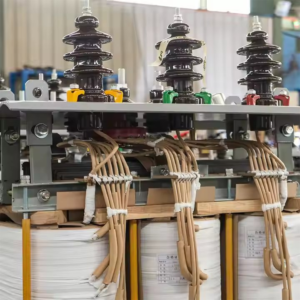
Transformer core cross-sectional area calculation formula.

(1) Transformer silicon steel sheet cross section: 3.2CM*3.4CM*0.9=9.792CM^2 (2) Calculate transformer power based on silicon steel sheet cross section: P=S/K^2=(9.79/1.25)^2=61.34 watts (take 60 watts) (3) Calculate the number of turns per volt of the coil based on the cross section: W=4.5*10^5/BmS=4.5*10^5/(10000*9.79)=4.6 turns/volt (4) Number of turns of the primary coil: 220*4.6=1012 turns ( 5) Primary coil current: 60W/220V=0.273A (6) Primary coil wire diameter: d=0.715 root 0.273=0.37(MM) (7) Secondary coil turns: 2*(51*4.6*1.03)=2*242(turns) (1.03 is the step-down factor, two-stage 51V=2*242 turns)   (8) Secondary coil current: 60W/(2*51V)=0.59A (9) Secondary wire diameter: d=0.715 root 0.59=0.55(MM)

Read More »

What Is Dry Type Transformer?

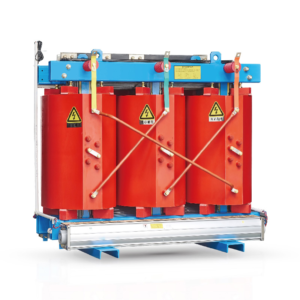
Table of Contents 1. What is a Dry Type Transformer? Structure and Operating Principles A dry-type transformer is a type of transformer where the core and windings are not immersed in insulating liquid, relying primarily on natural or forced air convection for cooling. Compared to oil-immersed transformers, dry-type transformers eliminate safety hazards such as oil leakage, fire, and explosions, better meeting the modern power system’s requirements for safety, environmental protection, and intelligence. 2. Advantages and Disadvantages of Dry Type Transformers Performance Characteristics of Dry-Type Transformers 1. High Safety Dry-type transformers utilize non-flammable resin that is inherently non-combustible, flame-retardant, and incapable of explosion or releasing toxic gases. They pose no risks to the environment, surrounding equipment, or human health. These transformers exhibit high resistance to humidity, dust, and pollution, with no risk of partial discharge during operation and zero possibility of insulation cracking over time. 2. High Reliability Both high-voltage and low-voltage windings are insulated with NOMEX® material and undergo multiple impregnations with H-class (180°C) solvent-free varnish using VPI (Vacuum Pressure Impregnation) equipment, followed by high-temperature baking curing. The transformer is rated for H-class thermal endurance (180°C), while its primary insulation material (NOMEX®) is rated for C-class (220°C), ensuring superior overload capacity

Read More »
Scroll to Top

Get In Touch