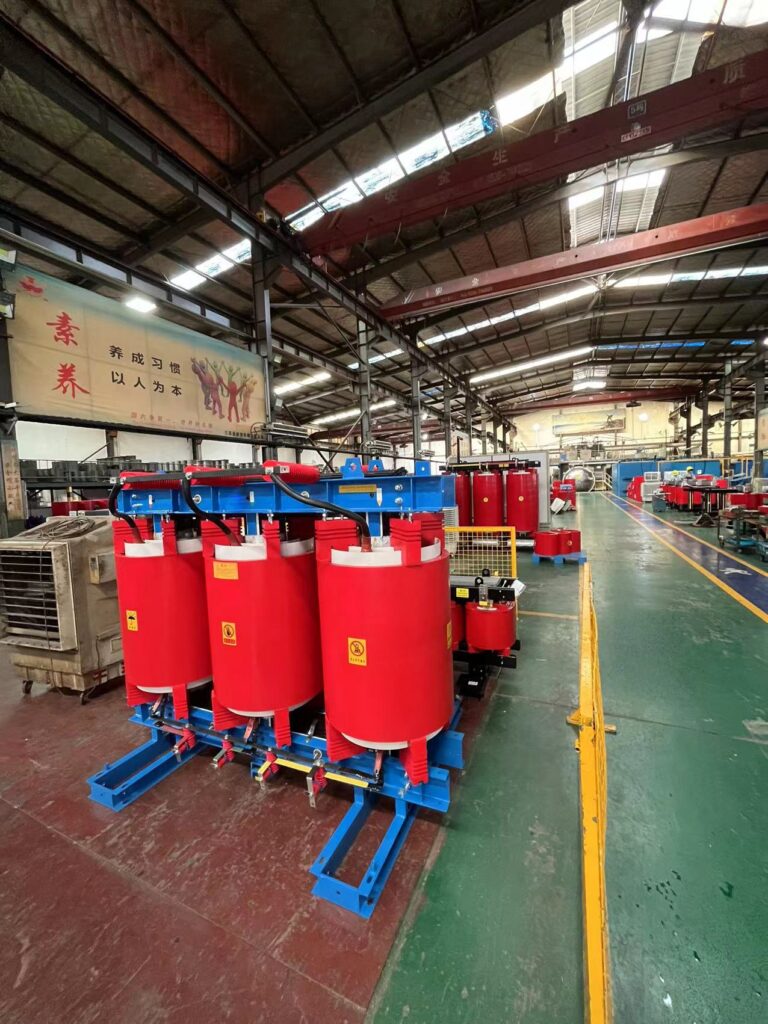




Transformers are responsible for the efficient transmission and conversion of electrical energy, regulating voltage and minimizing power loss. Therefore, transformer design plays a critical role in ensuring system reliability and operational safety.
This article provides a comprehensive explanation of transformer fundamentals — including basic structure, classifications, functions, selection criteria, design procedures, and typical applications.
Table of Contents
1. What types of power transformers are there, and what are their main components?
There are several types of power transformers, such as dry-type transformers, oil-immersed transformers, and pad-mounted distribution transformers.
Their main components typically include: the core, windings, insulation system, tank (for oil-immersed types), cooling system, tap changer, bushings, and other protective accessories.
2.What Is Magnetizing Current (Excitation Current)?
Magnetizing current is the excitation current needed to build magnetic flux inside the core.
When a transformer is energized, a high inrush current may occur.
If the residual flux has the same polarity as the applied voltage, the total flux can exceed core saturation, causing a surge up to 6–8 times the rated current.
This transient current contains DC components and harmonics and decays over time, typically 5–10 seconds for large transformers and ~0.2 seconds for smaller units.
3.Why should a new transformer or an overhauled transformer receive energization “impact tests” before official commissioning? How many times should it be energized?
Before a new transformer (or a transformer returned from factory overhaul) is put into service, several energization impact tests are required to verify insulation strength and mechanical reliability.
To verify insulation withstand against full-voltage or switching overvoltage.
When an unloaded transformer is switched off, the interruption of a very small magnetizing current may occur before its current reaches zero. The resulting current chopping in the breaker can produce switching overvoltage.
In non-grounded transformers or transformers grounded through an arc suppression coil, switching overvoltage can reach 4.0–4.5 times the phase voltage.
For transformers whose neutral point is directly grounded, switching overvoltage is typically below 3 times the phase voltage.
→ This is why transformers requiring impact tests must have their neutral point directly grounded.
To verify mechanical strength under high inrush current.
When an unloaded transformer is energized, an inrush current up to 6–8 times the rated current may occur. This surge produces significant electrodynamic force. Therefore, the impact test also confirms that the transformer’s mechanical strength and protective relays will not misoperate.
Recommended impact test counts:
New transformer: 5 energization impacts. Overhauled transformer: 3 energization impacts
4.What are the conditions for parallel operation of transformers?
Transformers can operate in parallel only when the following conditions are satisfied:
Identical turns ratio (voltage ratio)
Equal short-circuit impedance (short-circuit voltage)
Same vector group / winding connection group
5.What protection facilities are installed on a transformer body, and what are their main functions?
Typical protection facilities on a transformer body include:
Conservator (Oil Tank Extension)
Its capacity is approximately 8–10% of the total transformer oil volume.
Function: to absorb oil volume change due to temperature variation, reduce direct contact between oil and air, prevent moisture ingress and slow down oil oxidation.
A silica-gel breather is installed on the conservator to prevent humid air from entering the transformer.Breather (Moisture Absorber) and Oil Purifier
The breather contains desiccants such as silica gel activated alumina.
Color-changing silica gel is used (blue → red) as an indicator of saturation.
The oil purifier (filter) also contains desiccants to absorb moisture, acids, and oxidation products when oil passes through—keeping the oil clean and extending its service life.Explosion-relief device / Pressure relief device
Traditionally, an explosion-proof tube (safety vent) is mounted on the tank cover to release excessive internal pressure during internal faults.
Modern large transformers use pressure relief valves instead.
When internal pressure rises, the valve operates and triggers alarm or trip signals.
Additionally, transformers are equipped with other safety devices, such as:
Buchholz relay (gas relay)
Thermometers (temperature indicators)
Oil level gauges