





Amorphous Alloy Dry-type Transformers SCBH15/SCBH17/SCBH19 Series
Overview
Amorphous alloy dry-type transformer (SCBH series) is a high-efficiency and energy-saving equipment using amorphous alloy iron core and epoxy resin pouring technology, its no-load loss is reduced by 60%~70% compared with traditional transformers, with the advantages of oil-free fire protection, maintenance-free, low-carbon environmental protection, etc., can be directly installed in the load center, and is widely used in data centers, commercial buildings and green parks and other high-energy efficiency scenarios.
Brief Introduction
Ⅰ.Brief Intrucodtion
1.Customizable: support voltage level, capacity, protection level (IP20~IP55), cooling method (natural air cooling/forced air cooling), insulation level (F / H class) customization, adapt to different power grid standards and extreme environments (such as high altitude, high temperature, severe cold).
2.Implementation standard: in accordance with the international standard IEC 60076 series; Passed regional certifications such as EU CE (Ecodesign Energy Efficiency), North America UL 1561/CSA C22.2 No.47, China GB 20052-2020 (Level 1 Energy Efficiency); Meets environmental standards RoHS, REACH.
3.Voltage Rating: Standard 10kV/0.4kV, 6.6kV, 11kV, 20kV, etc. can be customized.
4.Voltage regulation method: standard no excitation voltage regulation, optional on-load voltage regulation (adapt to grid voltage fluctuations).
5.High voltage tap range: standard ±5% (5 stops), expandable to ±10% (9 stops, power-off operation).
6.Rated capacity: 50kVA~10000kVA, enhanced cooling can be extended to 3150kVA.
7.Frequency: Standard 50Hz, outlet can be customized 60Hz.
8.Phase number: three phases.
9.Connection group: standard Dyn11, customizable Yyn0.
10.Impedance voltage: standard 6%, adjustable in the range of 4%~8%.
11.Cooling Methods: Natural Air Cooling (AN), Forced Air Cooling (AF), Hybrid Cooling (AN/AF Smart Switching).
Protection level: standard IP20 (indoor), optional IP54 (dust and water resistance), IP65 (outdoor fully sealed).
12.Insulation Grade: Standard Class F (155°C), Optional Class H (180°C, suitable for high-temperature environments).
Ⅱ.working conditions
1.Altitude: ≤1000m (high altitude type can be customized to 4000m, volume reduction required)
2.Relative humidity: ≤90% (no condensation)
3.Installation location: indoor ventilation environment or outdoor (corresponding protection level required)
4.Rated frequency: 50Hz/60Hz
5.Maximum temperature: +40°C
6.Minimum temperature: -25°C (customizable – 50°C cold type)
7.Average daily temperature: +35°C
8.Average annual temperature: +20°C (exceeding the standard needs to be used for capacity reduction).
Ⅲ.Type of experiment
1.Routine tests: winding resistance measurement, voltage ratio measurement, short-circuit impedance measurement, load loss measurement, no-load loss measurement, power frequency withstand voltage test
2.Type test: temperature rise test, lightning impact test, sound level measurement, short circuit tolerance test
Ⅳ.Component inspection
1.Iron core: magnetic permeability, loss value detection
2.Winding: inter-turn withstand pressure, local volume detection
3.Insulation materials: heat resistance grade, flame retardant test
4.Cooling system: fan performance, protection level verification
V.Types of certifications
1.Safety certification: UL/CE/CQC
2.Energy efficiency certification: GB 20052 energy efficiency level 1
3.Environmental certification: RoHS/REACH
4.Special certifications: Explosion-proof certification (ATEX), classification society certification
Note: All products have passed a full set of routine tests before leaving the factory, and the type test report can be queried.
Structural Features
Ⅰ.Product characteristics:
1. Low No-Load Loss & High Efficiency: The use of amorphous alloy iron core has extremely low no-load loss and energy efficiency meets international first-class standards.
2. High Insulation & Humidity Resistance: Epoxy vacuum cast winding, high insulation strength, moisture and corrosion resistance, can operate in 100% humid environment.
3. Safe & Eco-Friendly (Oil-Free): Oil-free structure, fire and explosion-proof, low combustion toxicity, and excellent environmental protection.
4. Low Noise & Sensitive-Scene Fit: Optimize the core process and shock absorption design, low noise, and adapt to noise-sensitive places.
5. Optional Intelligent Monitoring: Optional temperature control system and IoT interface support remote monitoring to meet unattended needs.
Ⅱ.Product advantages
1.Extreme energy saving: SCBH15 reduces no-load losses by 60%, SCBH17 by 65%, and SCBH19 by 70% compared to traditional SCB12.
2.Safe and reliable: strong short-circuit resistance, high mechanical strength, can resist short-circuit current shock.
3.Environmental Compliance: With a recyclability rate of over 95%, it complies with environmental regulations such as RoHS and REACH.
4.Easy maintenance: The all-dry structure does not require complex maintenance and reduces operation and maintenance costs.
Ⅲ.Product advantages
1.Economy: SCBH19 saves more than 25% of annual electricity bills (800kVA capacity, 8000h operation) compared to traditional models, and the initial investment difference can be recovered in 3-5 years.
2.Environmental protection: Reduce CO₂ 2.4-3.5 tons/year (800kVA) throughout the life cycle to help customers achieve carbon neutrality goals.
3.Safety: No fire and pollution risk, can be installed in the load center to reduce transmission loss and potential safety hazards.
4.Adaptability: Wide temperature range operation, adaptable to a variety of complex environments, reducing equipment replacement costs caused by environmental restrictions.
Ⅳ.Evidence
1.Energy efficiency certification: The no-load loss data has passed the IEC 60076-20 energy efficiency test, meets the GB 20052-2020 first-level energy efficiency standard, and has obtained CQC/UL certification.
2.Safety verification: Passed IEC 60076-5 short-circuit resistance test and IEC 60076-3 insulation strength test, and provides type test report (TTR).
3.Environmental protection certificate: RoHS/REACH compliance certificate and SGS test report, material recycling rate of more than 95%.
4.Energy-saving case: A data center saves 280,000 yuan in electricity bills after using SCBH19, and the payback period is only 4 years.
5.Environmental adaptability: -50°C extreme cold start (GB/T 2423.1) and +60°C high temperature operation (GB/T 2423.2) test report, high-altitude solution (4000 meters) practical application case.
6.Noise control: 3rd party noise test report (such as SGS) showing noise ≤ 55dB (AN mode).
Product structure
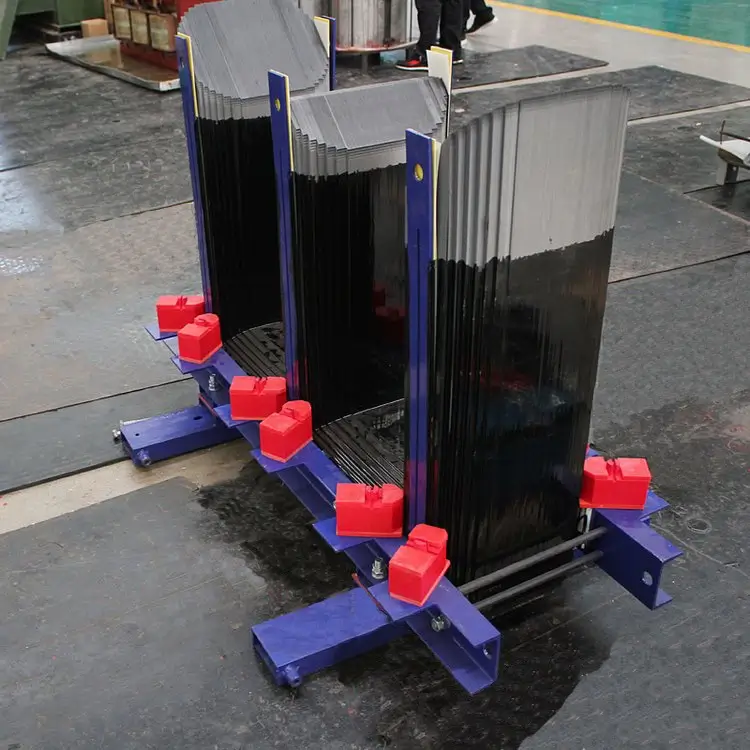
The structure of amorphous alloy Dry type transformers is similar to that of traditional Dry type transformers, but because the core material is made of amorphous alloy, there is a special optimization in the design of core components, the specific structure is as follows:
Ⅰ.Iron core
1.Material: The core is iron-based amorphous alloy strip (only 20-30μm thick), with extremely high permeability and very low iron loss (no-load loss is 50%-70% lower than silicon sheet core), which is the core source of its energy efficiency.
2.Structure: It adopts winding molding (amorphous alloy strip material is brittle and cannot be stacked like silicon steel sheets), continuously wound into a closed magnetic circuit by special equipment, and the outside is tied and fixed with a non-weft belt to reduce vibration and noise.
3.Protective treatment: The surface of the core is coated with insulating paint or epoxy resin to enhance the insulation performance and prevent oxidation of the amorphous alloy strip.


Ⅱ.Winding
1.Materials: mostly high-purity electrolytic copper (excellent conductivity), aluminum can be used in some scenarios (to reduce costs), and the surface of the wire is coated with an insulating layer (such as polyimide film).
2.Winding method: high-voltage windings are usually segmented and layered cylindrical type, using epoxy resin vacuum casting molding (enhanced insulation and mechanical strength); Low-voltage windings are mostly foil structures (large ampacity, good heat dissipation), isolated by DMD insulation material between layers, and equipped with cooling air ducts in the axial direction.
3.Cooperate with the core: The winding set is outside the amorphous alloy core, and the insulation gap is kept between the two to avoid the damage of the brittle material of the core by mechanical stress.
Ⅲ.Insulation system
1.Main insulation: epoxy resin as the core (high temperature resistance, strong insulation performance), with glass fiber mesh cloth (to enhance structural strength) and insulating paper (for interlayer and end insulation).
2.Process: The winding is cured by vacuum casting to ensure that the insulation material is tightly combined with the conductor, improving the ability to resist short circuits and insulation reliability.
Ⅳ.Cooling system
1.Natural air cooling (AN): Suitable for small and medium-sized volumes, heat dissipation through shell heat sinks and air convection, simple structure, maintenance-free.
2.Forced Air Cooling (AF): Large-capacity models are equipped with cooling fans that automatically start when the temperature is too high, enhancing heat dissipation efficiency and improving overload capacity.
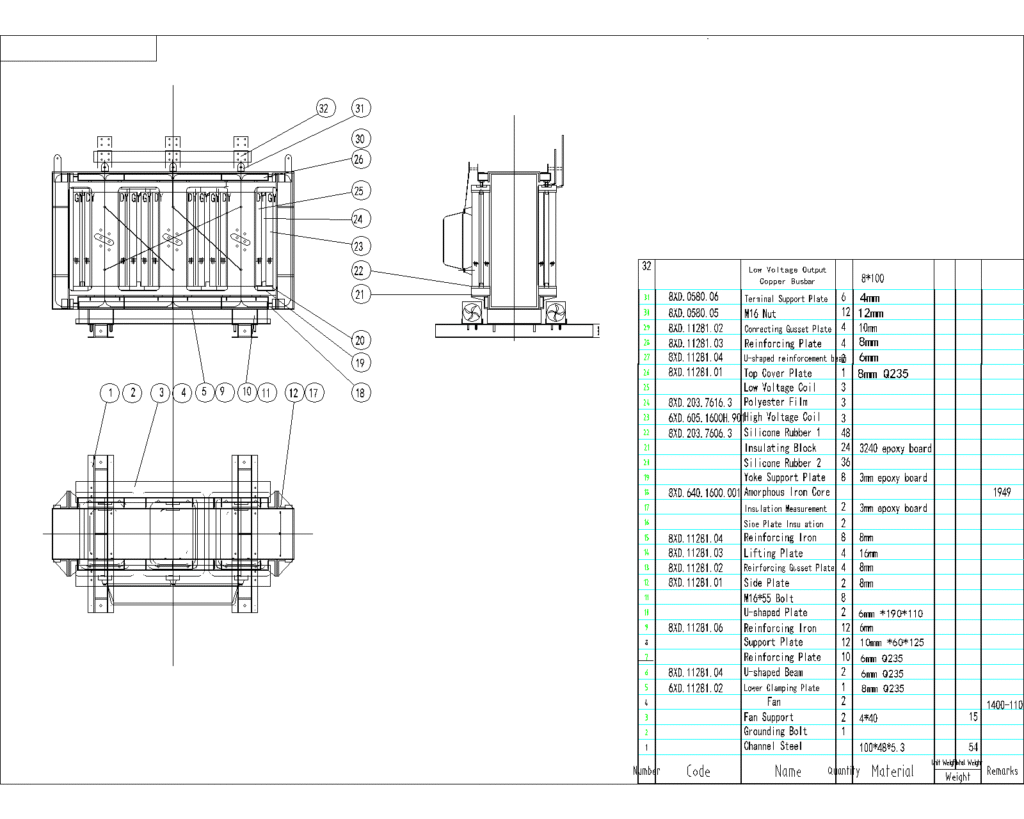
Ⅴ.Auxiliary parts
1.Temperature control system: built-in temperature sensor (buried in the winding) and intelligent controller, real-time temperature monitoring, with over-temperature alarm, trip protection function, can link the fan start and stop.
2.Housing: The protection level is mostly IP20 (indoor) or IP54 (outdoor), and the material is cold-rolled steel or stainless steel, which plays a role in dustproof, moisture-proof and safety protection.
3.Terminal Blocks: Copper or copper-aluminum transition terminals that support side outlet or ejector wires, ensuring reliable connection with external lines.
The most notable difference is the amorphous alloy core’s winding structure (replacing silicon steel sheet stacking) – it directly reduces no-load loss and improves energy efficiency, but the brittle core is more sensitive to vibration/impact, requiring enhanced fixation and protection in design.

Specification
10KV SCBH15/SCBH17/SCBH19 Series
| 额定容量(KVA)Rated capacity | 高压(KV)H.V | 低压(KV)L.V | 连接组标号Connection symbol | 空载损耗(KW)No-load loss | 负载损耗(KW)On-load loss | 短路阻抗(%)Short circult impedance | ||||
|---|---|---|---|---|---|---|---|---|---|---|
| 15 | 17 | 19 | 15 | 17 | 19 | |||||
| 30 | 6 6.3 6.6 10 10.5 11 |
0.4 | Dyn11/Yyn0 | 0.070 | 0.060 | 0.050 | 0.710 | 0.640 | 0.640 | 4.0 |
| 50 | 0.090 | 0.075 | 0.060 | 1.000 | 0.900 | 0.900 | ||||
| 80 | 0.120 | 0.100 | 0.085 | 1.380 | 1.240 | 1.240 | ||||
| 100 | 0.130 | 0.110 | 0.090 | 1.570 | 1.415 | 1.415 | ||||
| 125 | 0.150 | 0.130 | 0.105 | 1.850 | 1.665 | 1.665 | ||||
| 160 | 0.170 | 0.145 | 0.120 | 2.130 | 1.915 | 1.915 | ||||
| 200 | 0.200 | 0.170 | 0.140 | 2.530 | 2.275 | 2.275 | ||||
| 250 | 0.230 | 0.195 | 0.160 | 2.760 | 2.485 | 2.485 | ||||
| 315 | 0.280 | 0.235 | 0.195 | 3.470 | 3.125 | 3.125 | ||||
| 400 | 0.310 | 0.265 | 0.215 | 3.990 | 3.590 | 3.590 | ||||
| 500 | 0.360 | 0.305 | 0.250 | 4.880 | 4.390 | 4.390 | ||||
| 630 | 0.420 | 0.360 | 0.295 | 5.880 | 5.290 | 5.290 | ||||
| 630 | 0.410 | 0.350 | 0.290 | 5.960 | 5.365 | 5.365 | 6.0 | |||
| 800 | 0.480 | 0.410 | 0.335 | 6.960 | 6.265 | 6.265 | ||||
| 1000 | 0.550 | 0.470 | 0.385 | 8.130 | 7.315 | 7.315 | ||||
| 1250 | 0.650 | 0.550 | 0.455 | 9.690 | 8.720 | 8.720 | ||||
| 1600 | 0.760 | 0.645 | 0.530 | 11.730 | 10.555 | 10.555 | ||||
| 2000 | 1.000 | 0.850 | 0.700 | 14.450 | 13.005 | 13.005 | ||||
| 2500 | 1.200 | 1.020 | 0.840 | 17.170 | 15.445 | 15.445 | ||||
FAQS
Amorphous Alloy Dry-type Transformers SCBH15/SCBH17/SCBH19 Series FAQs
You may want to know the following questions and answers when purchasing.
Ⅰ.Basic Concepts
1. What are your main products?
Oil-immersed transformers, dry-type transformers, pre-installed substations, high and low voltage switchgear and supporting power equipment
Supplement: Covers 10kV-500kV full voltage level, maximum capacity 500MVA
2. How to choose the right capacity and voltage level?
It must be determined based on the nominal voltage, grounding mode, and maximum fault current of the system!
For example, a 10kV neutral point is grounded by an arc suppression coil, and the matching capacity is suitable according to 1.2 – 1.5 times the total capacitance current of the system. You only need to provide the grid parameters (voltage, load, grounding method, etc.), and our technical team will choose the model for free to accurately adapt to your system.
3.How to choose between dry-type transformers and oil-immersed transformers?
①Safety performance: dry type has no fire risk and can be close to densely populated areas; The oil-immersed type requires fire prevention measures, and leakage may pollute the environment.
②Applicable scenarios: dry type is used indoor, medium and low voltage (≤ 35kV), power ≤ 30MVA; The oil-immersed type is used outdoor, high voltage (≥ 110kV), power ≥ 30MVA.
③Maintenance cost: dry type only needs dust removal and winding inspection (1-2 years); The oil-immersed type requires regular oil testing, oil filtration/oil change (3-5 years).
④Environmental performance: dry type pollution-free, RoHS compliant; The oil-immersed type requires a leak-proof design, and synthetic ester oil is degradable but the cost is high.
⑤Energy efficiency performance: dry full load efficiency of 98%-99%, high temperature needs to be reduced capacity; The oil-immersed type has a full load efficiency of 99%+ and is suitable for high-temperature environments.
⑥Service life: dry type 20-30 years (H grade can reach 40 years); Oil-immersed type 30-50 years (when the oil quality is good).
Selection suggestions
Choose dry type: indoor installation, high safety requirements, and easy maintenance scenarios
Choose oil-immersed type: high-capacity, high-pressure, outdoor installation scenarios
4.What are the differences between 35kV Dry-type transformers and 10kV Dry-type transformers?
①35kV is suitable for large-capacity, high-voltage grid access scenarios above 2000kVA (such as regional substations, new energy booster stations), with higher insulation requirements (the withstand voltage value is about 2 times that of 10kV), and the structure is more complex;
②10kV is suitable for terminal power distribution below 2500kVA (such as factories and commercial centers), and the cost and maintenance are lower. The selection should give priority to matching the voltage and capacity requirements of the upper power grid.
5. How to choose Amorphous Alloy Transformers vs Epoxy Resin Transformers?
The core difference between the two lies in energy efficiency and cost characteristics, which are recommended to be selected according to actual application needs:
①Amorphous Alloy Transformer (SCBH)
No-load loss is 60-70% lower than traditional silicon steel transformers, with great long-term energy savings and strong environmental benefits.
Higher initial cost (core materials cost 30-50% more).
Best for long idle periods, stable loads, and electricity cost-sensitive settings: data centers, commercial buildings, hospitals.
②Epoxy resin transformer (SCB).
Low initial cost, mature silicon steel technology, better short-term value.
High mechanical strength, strong short-circuit resistance, low noise, and adapts well to complex environments.
Ideal for standard industrial power distribution, high short-circuit risk, or stability-critical scenarios: factories, general power systems.
Selection suggestions:
If the focus is on long-term energy saving, long operating time, and stable load, choose SCBH;
If you are concerned about initial cost, short-circuit resistance and wide adaptability, choose SCB.
6. Which transformer is recommended for typical application scenarios?
①Commercial complex: Dry-type transformer (AN cooling), high fire protection requirements, easy maintenance
②Offshore wind power booster station: oil-immersed transformer (synthetic ester oil), high power demand, anti-corrosion design
③Metro power distribution: dry-type transformer (H-class insulation), low-smoke halogen-free, moisture-proof and shockproof
④Oil platform: oil-immersed transformer (Ex d explosion-proof), explosion-proof certification, salt spray resistant
Notes:
①Dry-type transformer derating of 1% per 1°C at ambient temperature > 40°C
②The oil-immersed type needs to be equipped with an oil pool (capacity ≥ 100% oil volume) or a nitrogen fire extinguishing system
Large-scale projects can adopt the combination scheme of “dry change + oil change”
8.How to choose SCBH15, SCBH17, SCBH19 series?
①SCBH15: Suitable for projects with limited budgets but looking to save energy
basic energy-saving type, cost-effective balance, suitable for conventional commercial buildings and residential area power distribution.
②SCBH17: Excellent performance in terms of price/performance ratio
Lower loss, insulation upgraded to Class H, longer life, suitable for long-term operation scenarios such as hospitals and schools.
③SCBH19: The most energy-efficient, suitable for occasions with high electricity costs
Ultra-efficient, with a local discharge of < 3pC, it is suitable for data centers and projects with extreme energy efficiency requirements, with the most significant long-term electricity cost savings.
9. What is the payback period for amorphous alloy transformers?
Normally, due to the significant electricity saving benefits, the investment difference can be recovered through electricity cost savings within 2-3 years.
10. Are amorphous alloy transformers easy to damage?
Amorphous materials are brittle, but under our patented protection structure, the product has sufficient mechanical strength.
As long as the transport and installation are carried out according to the instructions, long-term reliable operation is guaranteed.
Ⅱ.Technical parameters
1. What are the specifications of Dry-type transformers (voltage rating, power capacity, insulation rating)?
①Rated voltage
600V to 35kV on the primary side, 208V-480V on the secondary side, can be customized
②Power capacity
• Low power: 5-500kVA (commercial buildings and small equipment)
• Medium power: 500-2500kVA (data centers, medium-sized factories)
• High power: 2.5MVA+ (substation, heavy industry), maximum capacity 25MVA
③Insulation grade
• Class A (105°C): General Environment
• Class B (130°C): Slightly higher temperature resistance requirements
• Class F (155°C): Industrial Harsh Environments (Mainstream Choice)
• Class H (180°C): High temperature (e.g. smelting, steel mill)
• Rated R (220°C): Extreme environment applications
We offer a full range of insulation grades and cooling solutions that support customization.
2. What is the efficiency level and energy efficiency standards?
①Efficiency performance
• No-load efficiency: up to 98%-99%
• Peak efficiency point of load: 60%-70% load
• Loss control: Reduce no-load and load losses through material and design optimization
Comply with global energy efficiency standards
②International standard: IEC 60076-20
• European Union: Ecodesign Regulation Tier 1 (2015) and Tier 2 (2021)
• North America: DOE 2016 in the United States, CSA C802.2 in Canada
• China: GB 20052-2020 (Level 1 Energy Efficiency Maximum)
• India: BEE Star Certification (1 to 5 Stars)
• ANZ: MEPS Energy Efficiency Specification
③Energy efficient design and technology
• Core material: high magnetic conductivity silicon steel or amorphous alloy, no-load loss reduced by 15%-30%
• Winding Optimization: Low-resistance copper windings or optimized aluminum winding designs to reduce load losses
• Insulation system: H/R grade high-temperature resistant material to improve thermal efficiency and life
• Intelligent cooling: intelligent temperature control and forced air cooling system dynamically adjust energy consumption
④Compliance benefits
• Economic benefits: 10%-30% reduction in energy costs over the life cycle
• Environmental Benefits: Reducing greenhouse gas emissions and supporting carbon neutrality
• Policy dividends: Meet DOE/EU Tier 2 and other standards, and enjoy tax rebates and subsidies
⑤The design, manufacture and inspection of dry-type transformers and all their parts and accessories produced by our company comply with the latest standards below.
• Basic general: IEC 60076-1 / GB/T 1094.1-2013, GB/T 1094.11-2022
• Energy efficiency and environmental protection: GB 20052-2020, T/CEEIA 258-2016
• Insulation withstand voltage: IEC 60076-3 / GB/T 1094.3-2017, GB/T 26218.1(2)-2010
• Test and testing: DL/T 596-1996, GB/T 50150-2016, IEC 60270 / GB/T 7354-2003
• Short circuit resistance: IEC 60076-5 / GB/T 1094.5-2008
• Temperature rise cooling: IEC 60076-2/GB/T 1094.2-2013, JB/T 8971-2013
• Acoustic performance: GB/T 1094.10-2022
• Protective structure: GB/T 4208-2008, JB/T 9639-1999
• Operation and maintenance: DL/T 572-1995
• High voltage test: GB/T 16927.1-2011 / GB/T 16927.2-2013
• Special applications: GB/T 10228-2023, GB/T 1094.12-2013
3.What are the cooling methods (natural air cooling, forced air cooling) for dry-type transformers?
①Natural cooling (AN)
• Features: Fanless, silent design (<55dB)
• Applicable: Below 2500kVA, silent places such as commercial buildings
• Advantages: Zero additional energy consumption, maintenance-free and low cost
②Forced Air Cooling (AF)
• Features: Fan heat dissipation, support overload operation
• Applicable: above 1000kVA, high temperature and high load scenarios such as industrial plants
• Advantages: Increase capacity by 25-50%, adapt to harsh environments
③Hybrid Cooling (AN/AF)
• Features: Intelligent temperature control automatic switching
• Applicable: Data centers and other situations where the load fluctuates
• Advantages: Energy saving of 30-50%, both silent and efficient
Selection suggestions:
• Commercial premises: Natural cooling (AN)
• Industrial Scenario: Forced Air Cooling (AF)
• Fluctuating Load: Hybrid Cooling (AN/AF)
Customization options such as IP54 dustproof fans and intelligent temperature control are available.
4. Are there customizable options for specific applications?
Support full parameter customization (voltage 0.4-500kV, frequency 50/60Hz, protection level up to IP68, special environment adaptation)
①Electrical parameter customization: voltage 0.4-35kV input, 0.23-13.8kV output; capacity 10kVA~25MVA (expandable to 50MVA).
②Material selection: copper winding (efficiency 98.5%+) or aluminum winding (cost reduction of 30%); Oriented silicon steel or amorphous alloy core
③Cooling system: AN/AF/AN+AF intelligent switching; Heat pipe assists heat dissipation (temperature rise and fall 15K).
④Protection design: IP23 to IP66; Galvanized steel or 316 stainless steel (salt spray test > 1000h).
⑤Special environmental adaptation: high-altitude capacity correction; Explosion-proof certification (ATEX Zone 1/2).
⑥Intelligent functions: PT100 temperature measurement + IoT monitoring (4G/fiber); Dynamic volume adjustment technology
⑦Installation adaptation: floor-mounted, wall-mounted (≤500kVA), rail type; Narrow body structure (width compression 20%)
⑧Industry special customization: wind power special (anti-vibration, anti-tilt); Mining transformer (reinforced enclosure + 150% overload capacity).
⑨Global certification support: UL+cUL (North America), CE+TUV (EU), CQC+Energy Efficiency Label (China).
⑩Customized Processes: Requirements analysis→ scheme design→ prototype testing→ mass production
⑪Value-added customized cases: data center efficient silence solution, Antarctic research station extreme cold solution, chemical plant explosion-proof solution
Note: The non-standard customization cycle is 30%-50% longer, and there may be additional costs for extreme environment design.
Ⅲ.Installation and application
1. What are the installation requirements and space considerations?
①environmental conditions
• Temperature: Standard ambient ≤ 40°C, overtemperature needs to be reduced (1% reduction for every 1°C increase)
• Humidity: Relative humidity < 95% (no condensation), IP55 shell is required for humid environments
• Pollution level: Coastal areas need Level IV protection design
②Space requirements
• Natural cooling (AN): 600mm ≥ all sides, 800mm ≥ top
• Forced air cooling (AF): 300mm ≥ on the inlet side and 500mm ≥ on the outlet side, reserving space for maintenance
③Foundation vs. fixation
• Foundation load-bearing: ≥1.5 times the weight of the transformer (including accessories)
• Mounting method: Floor-mounted (M16 anchor bolts), wall-mounted (load-bearing bracket≥ 200% safe load)
• Seismic fortification: Shock absorbers are installed
④Electrical safety
• Safety distance: 125mm between phases ≥of 10kV system, 100mm ≥ to ground (35kV requires ≥300mm)
• Grounding resistance: ≤4Ω (independent grounding), multiple units need to ≤ 1Ω
• Cable bending: Cross-linked cable ≥ 15 times the diameter
⑤Protective measures
• Enclosure protection: IP54/IP65 outdoor, IP20 indoor
• Fire protection requirements: F1 flame retardant (flame spread ≤ 100mm), refractory materials (≥2h)
⑥Special environment
• Explosion-proof area: Zone 1 requires ATEX certification (flameproof enclosure Ex d)
• High altitude: 1% capacity reduction for every 100m of elevation at > 1000m
It is recommended to have professional engineers guide the installation on site.
2. What is the maximum operating altitude and temperature range?
①Altitude adaptability
• Standard range: ≤1000m
• High altitude scheme (1000-5000m): 1% capacity reduction for every 100m of elevation, strengthening insulation, and upgrading forced air cooling
Example: A 2000kVA transformer has an usable capacity of 1500kVA at 3500m
②Temperature adaptability
• Conventional range: -25°C~+40°C (natural cooling)
• Low temperature scheme (-50°C): pre-heating device (PTC heater) + H-class insulation
• High temperature solution (+60°C): 1% volume reduction per °C when exceeding 40°C, using hybrid cooling (AN/AF automatic switching)
③Special environment configuration
High altitude type (4000m+): Pressurized air duct + anti-corona treatment
Extreme cold type (-50°C): low-temperature lubricating oil + stainless steel fasteners
Desert type (+60°C): sunscreen coating (reflectivity ≥80%) + IP54 + sand and dust resistant seal
④Typical application scenarios
• Plateau substation (3000m, -30~+35°C): 15% capacity reduction + H-class insulation + AF cooling, 25 years of life
• Polar research station (-50~+20°C): pre-heating system + fully enclosed IP55, life of 20 years
• Middle East Oilfield (-10~+55°C): Mixed cooling + sunscreen + corrosion-resistant plating, 18 years of life
Support customized solutions according to specific altitude and temperature.
3. What are the noise levels during operation and do they comply with local regulations?
①Noise source and range
• Core magnetostriction: 45-60dB
• Cooling system: natural cooling 40-55dB, forced air cooling 55-70dB
• Load impact: 30% load drop by 5dB, 100% load increase by 3-5dB
②Noise reduction technology and effect
• Core optimization (stepped lamination + high magnetic conductivity silicon steel): 5-8dB reduction, cost +8-12%
• Cooling system noise reduction (low-noise fan + variable speed control): 10-15dB reduction, cost +5-10%
• Vibration isolation installation (rubber mat + spring bracket): 3-5dB reduction, cost +3-5%
• Sound insulation cover (double-layer steel plate + sound-absorbing cotton): 15-25dB reduction, cost +15-25%
③Scene noise limit
• Residential area at night: ≤45dB (AN cooling + vibration isolation required)
• Commercial Daytime: ≤60dB (AF Cooling + Basic Vibration Isolation Allowed)
• Industrial area: ≤75dB (can be directly installed with AF cooling)
④Testing and customization
• Test standard: Background noise is 10dB lower than the sound source, measurement distance 1m (ANSI) or 0.3m (IEC)
• Ultra-quiet solution: ≤ 48dB (2000kVA) in AN mode, equipped with step laminated iron core + silicone rubber shock absorber
Note: The actual noise needs to consider on-site factors, and it is recommended to simulate the sound field.
Ⅳ. Operation and maintenance and assurance
1. Does it require special maintenance during operation?
No! Routine maintenance once every 1-2 years is sufficient, mainly for surface dust removal, insulation resistance measurement, and grounding connection check; Forced air-cooled models have their lower fan status checked annually.
Compared with oil-immersed transformers, the dry structure is maintenance-free, saving the troubles of oil change and oil level checking, and the operation and maintenance cost is much lower.
2. What is the life expectancy of a dry-type transformer under normal operating conditions?
①Life expectancy
• Standard condition: 20-30 years (regular load, indoor environment, basic maintenance).
• Ideal conditions: more than 40 years (optimized load, strict maintenance, class H insulation).
• Harsh environment: < 15 years (high temperature and high humidity/no protection).
②Life factors and maintenance points
• Material selection
Adopt H-grade insulation to extend the life by 5-10 years
Amorphous alloy/high magnetic conductivity silicon steel core can extend the life of 10-15 years
• Operational control
Optimal 80% load rate
For every 10°C increase in ambient temperature, life is reduced by 50%
Harmonic THD>5% will shorten the life by 20%-40%
• Environmental requirements
Indoor: Humidity < 70% + regular dusting
Outdoor: IP55/IP65 protection required
• Maintenance measures
Real-time monitoring of hot spot temperature (H-level ≤ 180°C)
Annual inspection: winding resistance, partial discharge
Three-year test: short-circuit impedance
Continuous monitoring of harmonic THD (target<5%)
③Life extension program
• Customized solution: H-grade insulation + copper winding (promised 35 years of life, annual inspection required)
• Intelligent monitoring: Install IoT remote monitoring system
• Maintenance plan: Establish a preventive maintenance system and record operating data
By optimizing material selection, operational control, and maintenance strategies, dry-type transformer lifespan can be significantly extended. It is recommended to choose the appropriate configuration and maintenance scenario according to the specific application environment.
3. Can the equipment adapt to the complex installation environment of overseas projects (such as high temperature in the Middle East and high humidity in Southeast Asia)?
Strong environmental adaptability! For high temperatures in the Middle East, H-class insulation (withstand 180°C) + forced air cooling scheme is available;
In the face of high humidity in Southeast Asia, it adopts moisture-proof epoxy resin + IP54/IP65 protection (dustproof and waterproof), -25°C~+50°C wide temperature range design, covering extreme environments such as deserts and rainforests.
4. What are the protective measures for equipment damage during transportation?
Triple transportation protection!
①Packaged in a fully enclosed wooden case (in line with international shipping standards), filled with cushioning material;
②additional reinforcement of key components (windings, cores);
③Provide sea/air reinforcement solutions, with detailed installation and commissioning guides, and can remotely guide acceptance after arrival.
5. Do you provide product warranty? If there is a problem with the operation of the equipment, how to ensure the service?
The basic warranty is 24 months, which can be extended to 5 years
Supplement: Warranty covers manufacturing defects with free remote technical support
Worldwide quick response! 7×24 hours Multilingual remote technical support (English, Spanish, Arabic, etc.); Overseas core regions (Europe, America, the Middle East, Southeast Asia) promise 72-120 hours of on-site service; Configure full-time overseas service representatives for full-cycle follow-up, 10-year spare parts supply (price ≤110% of the original price), and a team of certified engineers to quickly repair faults.
6. Certification and testing requirements
Our dry-type transformer products meet the world’s mainstream certification requirements and pass rigorous extreme conditions to provide customized solutions for special application environments.
①Certification system
Quality Management System: ISO 9001, ISO 14001, ISO 45001
International electrotechnical standards: IEC 60076-11, IEC 60076-16, IEC 60529
②Regional Market Certification:
• NA: UL 1561, UL 1446, CSA C22.2 No.47
• EU: RoHS, REACH, EU Ecodesign
• US: DOE 2016, ANSI/IEEE C57.12.01
• UK: BS EN 60076-11
Special application certifications: DNV GL/ABS (Marine/Offshore Platforms), IEC 60332-3/IEC 61034 (Fire Safety).
③Validation test
The product has been tested under a number of extreme conditions to ensure reliability:
• High altitude test: IEC 60076-3 (power frequency withstand voltage test, +20% voltage).
• Low temperature start test: GB/T 2423.1 (-50°C cold start, 2 hours).
• High temperature operation test: GB/T 2423.2 (+60°C continuous full load thermal stability test).
④Selection suggestions
• Base Market: ISO 9001 + IEC 60076-11 + Regional Safety Certifications (UL/CSA/CQC).
• EU market: RoHS/REACH/EU Ecodesign added
• Special environments: Optional IP protection, wind power or marine certification
The company’s products have passed international mainstream certifications, supporting global market compliance access, and can provide customized solutions for specific application needs.
7. Can you provide support if the project requires third-party testing or local certification assistance?
Full cooperation!
We can assist in contacting international testing institutions such as SGS and Intertek to provide factory test reports and certification documents.
For overseas special certifications (such as SASO in the Middle East and CSA in North America), the technical team assists in the preparation of materials and on-site testing throughout the process to ensure the implementation of project compliance.
Ⅴ. Frequently Asked Questions
1. When will I get the price?
After receiving the complete technical parameters, within 24 hours for standard products and 48 hours for customized products
Key parameters such as rated capacity, voltage level, and insulation level need to be provided
2. How long is the delivery time?
15 working days for standard products, 25-40 working days for customized products
Expedited service can be reduced to 10 working days (20% expedited fee)
3. How much does it cost to ship?
Sea freight about $800-$3000/container (40HQ), land freight $0.5-$1.2/km
Provide EXW/FOB/CIF and other trade terms, including professional export packaging
4.What are Payment Terms?
We offer flexible payment options, the common ones are:
T/T: 30% deposit, 70% paid before shipment.
L/C: Accept L/C at sight.
For long-term cooperation, we can provide more favorable terms.
5. What are your advantages?
①61 years of manufacturing experience (established in 1963), fully automatic production line (±0.1mm accuracy), ISO 9001/14001 dual certification, 48-hour global emergency service
②Spare sleeves, special kits, and multilingual manuals are included with the goods
③Free installation guidance videos, lifetime cost optimization consultation, trade-in discounts for old equipment, and exclusive energy efficiency audit services for strategic customers
6. After-sales support comparison
①Regular consultation: response time within 2 hours, operation guidance, parameter query, support 400 call/WhatsApp
②Emergency fault handling: response time within 30 minutes (7×24 hours), remote diagnosis + on-site engineer dispatch (72 hours worldwide arrival).
③Preventive maintenance: appointment arrangement, annual inspection + oil sample testing (oil immersion type), customer portal independent appointment
Note: Export products meet IEC standards, and additional UL/CE/PES and other certifications can be provided (cycle increase by 2-3 weeks). Customized products require a 30% advance payment, and the 3D model is provided before production.
7. How long is the warranty?
We offer a standard warranty of 5 years from the date of commissioning, covering defects in materials and workmanship. The amorphous alloy core itself comes with a 10-year warranty.
Why Choose us ?
Built to last, engineered to perform.
Kete Transformer is a key national-level manufacturer specializing in transformers, recognized as a “Contract-Honoring and Promise-Keeping” enterprise, a high-tech enterprise, and a national-level enterprise technology center. It is recommended in the national directory for rural and urban power grid construction and renovation, as well as a recommended supplier of major electromechanical equipment for hydropower projects. Its products have been awarded the title of “National Quality Inspection Qualified Product – Quality Trustworthy Product” and “Nationally Recognized Product for Mechanical Industry Users.
Our Project
Our products not only dominate the domestic market but are also exported to more than 30 countries and regions, including Russia, Southeast Asia, Africa, and the Americas, serving industries such as power, municipal engineering, metallurgy, and petrochemicals.