





Prefabricated Substation(Chinese style box)
Overview
Prefabricated Substation(Chinese style box) is a prefabricated complete set of equipment that combines the characteristics of China’s power grid, regional cultural features and modern power distribution technology. It integrates core electrical components such as high-voltage switches, distribution transformers, low-voltage devices, and metering systems into a modular sealed box according to the national standard wiring scheme.
Brief Introduction
Ⅰ.Brief Intrucodtion
1.Customization: Exclusive designs are provided for different scenarios – the “landscape compact type” is adopted in the urban core area, incorporating the Anhui-style sloping roof and new Chinese-style grille; the “economical and durable type” is launched in rural areas to enhance dust and moisture resistance; the “grid-connected type” is adapted for new energy projects and reserved for photovoltaic/wind power interfaces; for electromagnetically sensitive scientific research and medical scenarios, a special electromagnetic shielding layer can be installed.
2.Compliant Standards: Strictly compliant with Chinese and international standards, including GB/T 17467 (National Standard for Prefabricated Substations) and GB 1094 (National Standard for Power Transformers). Compatible with international standards such as IEC 62271-202 and IEEE C57.12.00, the system meets the needs of both domestic and international projects.
3.Voltage Levels:
①High-voltage side: Mainstream 6kV, 10kV, and 35kV (compatible with mainstream domestic distribution grid levels), with customization available for special voltages such as 11kV and 20kV to accommodate the differentiated needs of regional power grids.
②Low-voltage side: Standard 0.4kV (380V/220V), with customization available for industrial voltages such as 0.69kV to meet the specialized power requirements of factory power equipment and large commercial complexes.
4.Voltage Regulation Methods:
①Off-excitation voltage regulation: Simple structure and cost-effective, with a tap range of ±5%, suitable for stable loads in rural and suburban areas, such as agricultural irrigation and rural residential power supply.
②On-load voltage regulation: Supports automatic or manual voltage regulation with a tap range of ±2 × 2.5%, quickly responding to load fluctuations. Suitable for demanding voltage quality scenarios such as urban commercial centers, data centers, and precision manufacturing plants, ensuring stable operation of sensitive equipment.
5.High-voltage tap range: Conventional ±5% or ±2 × 2.5%. For example, at 10kV, the ±5% range allows for three voltage settings: 9.5kV, 10kV, and 10.5kV, adapting to grid voltage fluctuations and ensuring stable output.
6.Rated Capacity: Rated capacity ranges from 30kVA to 8000kVA, meeting the power needs of users of varying sizes.
7.Other Information:
①Power Supply: Three-phase. Default connection group: Dyn11 (suitable for non-linear loads, such as inverters and charging stations) and Yyn0 (suitable for three-phase balanced loads, such as those in general factories and residential areas).
②Impedance Voltage: 4%-8%, customizable based on system short-circuit current and load characteristics.
③Cooling Method: Oil-immersed self-cooling (ONAN, for general use), Oil-immersed air-cooling (ONAF, for large-capacity, high-load use), Dry air-cooling (SCB series, for shopping malls and hospitals with strict fire protection requirements).
④Protection Rating: Basic IP33 (for general outdoor environments), customizable IP54 (for rainy and dusty areas), IP65 (for coastal areas with high salt spray and chemical corrosion).
⑤Insulation Class: B (130°C, economical and practical), F (155°C, high-temperature resistance), H (180°C, for long-term high-load operation). Select the appropriate level based on ambient operating temperature and load factor.
Ⅱ.Operating Conditions:
1.Altitude: ≤ 1000 meters. Custom reinforced insulation design available for high-altitude areas.
2.Ambient Temperature: -25°C to +40°C
3.Relative Humidity: Daily average not exceeding 95%, monthly average not exceeding 90%
4.Maximum Monthly Average Temperature: +35°C
5.Maximum Annual Average Temperature: +20°C
6.Minimum Ambient Temperature: 25°C (outdoor)
7.Maximum Daily Temperature Difference: 25°C
8.Sunlight Intensity: 0.1W/cm² (0.5m/s)
9.Seismic Resistance: 0.2g horizontal ground acceleration; 0.1g vertical ground acceleration
10.Installation Location: Free from severe vibration, corrosive gases, explosive media, and heavy dust. Suitable for locations such as urban roadsides, residential green belts, and industrial park vacant lots.
11.Applicable Areas: Widely used in urban power grid renovation (such as power distribution upgrades in older residential areas), new rural development, industrial parks (such as manufacturing clusters), commercial complexes, municipal projects (such as subway stations and stadiums), and new energy projects (photovoltaic power stations and wind farms).
Ⅲ.Test Types:
1.Type Tests: Insulation withstand voltage test (2.5 times the rated voltage on the high-voltage side for 1 minute without breakdown), short-circuit withstand test (25kA/3s), temperature rise test (oil top temperature ≤ 95°C under full load), protection level verification (IP rating measurement), mechanical life test (switching operation ≥ 10,000 times), internal arc test (verification of arc fault protection capability).
2.Routine Tests: Loop resistance test (≤ 50μΩ), power frequency withstand voltage test, mechanical operation test (smooth switching), transformer parameter test (turn ratio, polarity, no-load loss).
3.Special tests: Noise test (≤ 50dB@1m in residential areas), EMC test (in accordance with GB 17625.1), high and low temperature cycle test (-25°C to +40°C alternating), salt spray test (≥ 500h in coastal areas).
Ⅳ.Component Testing:
1.Transformer: Oil-immersion testing of insulating oil withstand voltage (≥30kV), dielectric loss (≤0.005), and moisture content (≤10ppm); dry-type testing of partial discharge (≤10pC) and temperature rise (F-class ≤100K).
2.High-voltage components: Fuse characteristic test (breaking capacity in accordance with GB 10963), lightning arrester residual voltage test (10kV class residual voltage ≤50kV), high-voltage switch circuit resistance (≤100μΩ).
3.Low-voltage units: Circuit breaker breaking capacity (≥50kA), busbar contact resistance (≤20μΩ), reactive power compensation device capacity accuracy (±5%).
4.Enclosure: Dust and water resistance test (measured according to IP rating), mechanical strength test (resistant to 1500Pa wind pressure, 20J impact), anti-corrosion coating thickness (≥80μm, adhesion ≥5MPa).
Ⅴ.Certification Types:
1.China Certifications: GB/T 17467 Compliance Certification, CQC Voluntary Product Certification, State Grid/China Southern Power Grid Grid Access Qualification;
2.International Certifications: IEC 62271-202 (International Electrotechnical Commission), CE (European Union), AS/NZS 60076 (Australia and New Zealand Standard);
3.Industry Certifications: ISO 9001 Quality Management System Certification, ISO 14001 Environmental Management System Certification, OHSAS 18001 Occupational Health and Safety Certification.
Structural Features
Ⅰ.Product Features:
1.Chinese Landscape Integration: The enclosure can be customized with a modern Chinese style—for example, with a blue-gray tile-patterned finish, wood-grained grilles, carved ornamentation, or emulating the “sloping roof” and “horse-head wall” designs of traditional dwellings. This design blends harmoniously with urban gardens, rural landscapes, and historic architectural conservation areas, avoiding the “industrial” feel of traditional substations that clash with the environment.
2.National Standard Adaptation and Optimization: Core components (such as transformers and switches) are designed according to national standards and compatible with domestic operation and maintenance tools and practices. For example, the high-voltage cabinet features a center-mounted structure for easy maintenance, and the low-voltage output line adopts a common drawer-type design, allowing module replacement without power outages.
3.Extreme Environment Resistance: The enclosure undergoes special anti-corrosion treatment (hot-dip galvanizing and UV-resistant coating) to withstand temperatures ranging from -25°C to +40°C. IP54 and above protection levels protect against heavy rain and dust. Optional 304 stainless steel with salt spray coating is available for coastal areas, extending the service life to over 20 years
Ⅱ. Product Advantages
1.Efficient Installation: Pre-installation, wiring, and commissioning are completed at the factory. On-site installation only requires foundation installation and cable connection, shortening the installation period to 1-2 days (compared to 1-2 weeks for traditional substations). This significantly reduces the impact of on-site construction on traffic and residents’ lives.
2.Sufficient Safety Redundancy: The high-voltage side is equipped with a mechanical interlock to prevent accidental operation while energized. The transformer adopts a short-circuit-resistant design, and the enclosure is equipped with an explosion-proof pressure relief device. These features comply with the safety requirements of GB 50053, “Design Specifications for Substations 10kV and Below,” reducing the risk of accidents.
3.Easy Maintenance: The modular component design allows for quick replacement of high-voltage switches, low-voltage drawers, etc. The enclosure is tightly sealed, reducing dust and moisture intrusion. Daily checks only require checking the oil level and temperature control status. The average annual maintenance frequency is reduced by 60% compared to traditional substations.
Ⅲ. Product Benefits
1.Cost Savings: The compact design reduces land usage (only 1/3-1/2 that of traditional substations), lowering land acquisition and construction costs. Rapid installation reduces labor and construction costs, resulting in annual maintenance costs over 40% lower than traditional substations.
2.Improved Reliability: Strict national standard testing and extreme environment testing ensure an average annual downtime of ≤4 hours and a fault isolation time of ≤0.5 seconds, meeting the continuous power supply needs of both residents and industry.
3.Shortened Construction Time: From order placement to commissioning, the system takes only 4-6 weeks (compared to 3-6 months for traditional substations), enabling rapid power supply for projects such as new residential communities and industrial parks.
ⅣEvidence
1.Certification and Testing: Passed full GB/T 17467 testing and CQC certification, with type testing verifying 25kA/3s short-circuit withstand capability, IP54 protection, and -25°C low-temperature startup stability.
2.Application Cases: Excellent performance in multiple domestic projects – In a renovation project for an older residential community in a provincial capital city, 50 landscape-style substations achieved a 60% increase in installation efficiency and a five-year failure rate of less than 2%. A photovoltaic power station, using a customized grid-connected substation, achieved a 100% grid connection success rate and stable operation.
3.Measured Data: A third-party test report shows a short-circuit withstand capability of 25kA/3s, noise level ≤50dB (at a distance of 1 meter), and an insulating oil breakdown voltage ≥30kV. All indicators exceed national standards.
Product structure
Ⅰ.Overall Structural Design
1. Overall Structural Design
①Standards:Complies with GB 50053 (Design Specifications for Substations 10kV and Below) and GB/T 17467 (Standard for Prefabricated Substations), and is earthquake-resistant.
②Full Protection Rating: Outdoor enclosure rated IP54 (basic version) and IP65 (enhanced version), with internal switchgear compartment rated IP2X, providing protection against electric shock and foreign object intrusion. Compliant with GB 50260 (Code for Seismic Design of Power Facilities), it is suitable for use in China’s frequent seismic zones.
2. Modular Composition
The system features a “three-compartment, separated” modular design with clear functional divisions, facilitating maintenance and expansion:
①High-voltage switchgear compartment: Integrates high-voltage circuit breakers/ring main units, lightning arresters, and high-voltage metering devices in a centrally located design with ample operating space.
②Transformer compartment: Houses oil-immersed/dry-type transformers, equipped with a temperature control system, oil level gauge (for oil-based transformers), and pressure relief valves (for oil-based transformers). Independent compartments minimize heat transfer.
③Low-voltage distribution compartment: Contains low-voltage switchgear, reactive power compensation devices, smart meters, and a monitoring system. Its drawer-style design facilitates component replacement and expansion.
Ⅱ.Core Structural Components
1. Cabin Structure
①Materials:
The outer shell is constructed of 2mm thick aluminum-zinc-coated steel (standard version) or 304 stainless steel (anti-corrosion enhanced version). The coating complies with GB/T 18226 (Corrosion Protection Requirements for Steel Structures in Highway Traffic Engineering), and has a salt spray test of 500 hours or more
②Frame: Utilizes hot-dip galvanized steel beams (GB/T 13912), with a wind pressure resistance of 1500Pa or more.
③Layout: Single cabin (small capacity, width ≤ 2.5m, convenient for rural road transport) or split cabin (large capacity, modular assembly, width ≤ 3m). The roof features a 5° or greater tilt to prevent water accumulation, and ventilation grilles (with dust and insect screens) on the sides ensure both heat dissipation and protection.
Appearance: Customizable with modern Chinese elements such as a grayish-gray tile-pattern finish, wood-textured side panels, and carved ornaments to blend in with the surrounding environment.
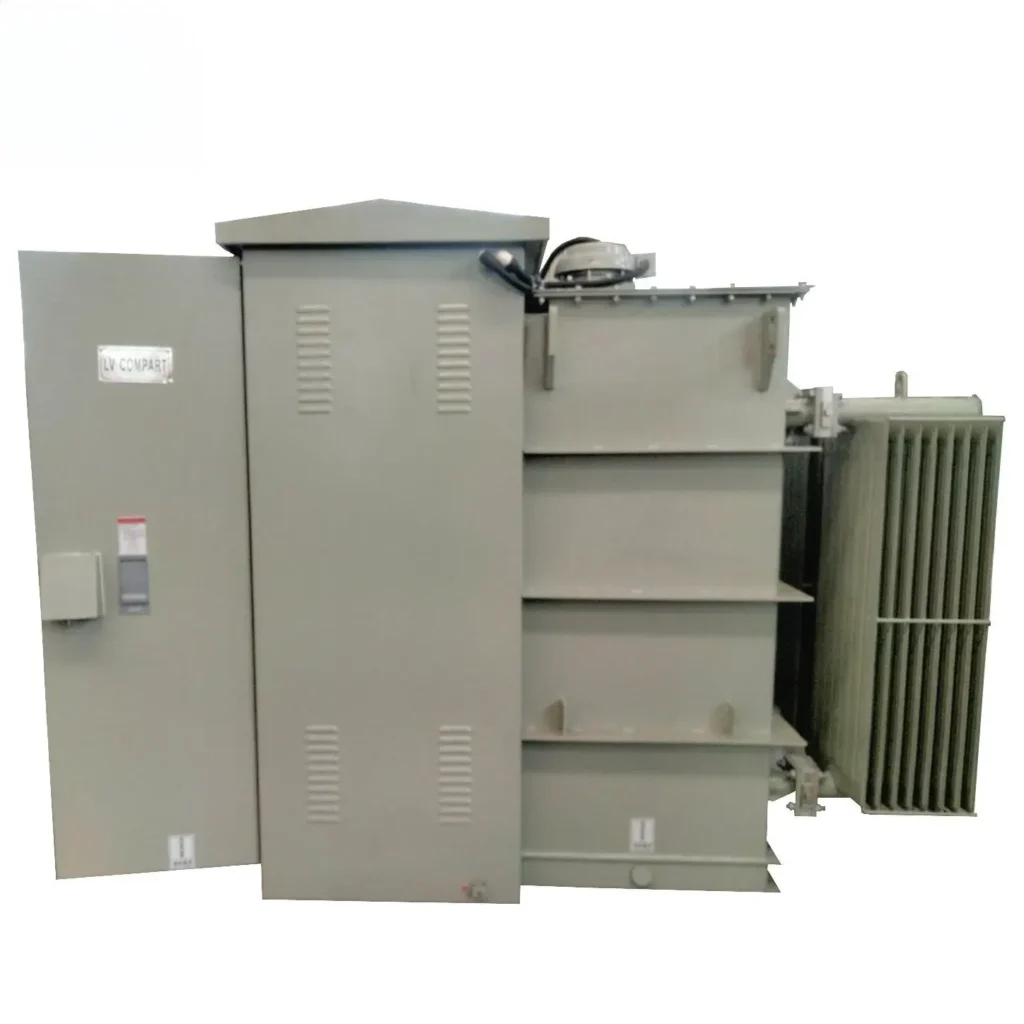
2. Transformer Compartment
Independent, enclosed compartment equipped with UL 94 V-0 fireproof partitions to prevent the spread of fire.
①Temperature Control System: Oil-immersed type with oil temperature sensor and cooling fan (automatically activated when temperature ≥ 85°C); dry-type type with winding temperature sensor and air cooling system, alarm threshold ≤ 90°C.
②Protection Design: The oil-immersed type features a leak-proof oil pit; the dry-type type utilizes epoxy resin insulation to prevent moisture.
3. High and Low Voltage Equipment Layout
①High-voltage side: Use mainstream domestic vacuum circuit breakers (compliant with GB 1984) or SF6 insulated ring main unit (RMU). Cable connectors conform to standard domestic standards for easy on-site wiring.
②Low-voltage side: Fame circuit breakers (compliant with GB 10963) and drawer-type low-voltage cabinets. Busbars utilize copper busbars (T2 copper, compliant with GB/T 5585), with insulation coverings conforming to GB/T 12706.
③Wiring: Separate high and low voltage currents to prevent interference. Ample space is reserved for cable trenches to facilitate future expansion..
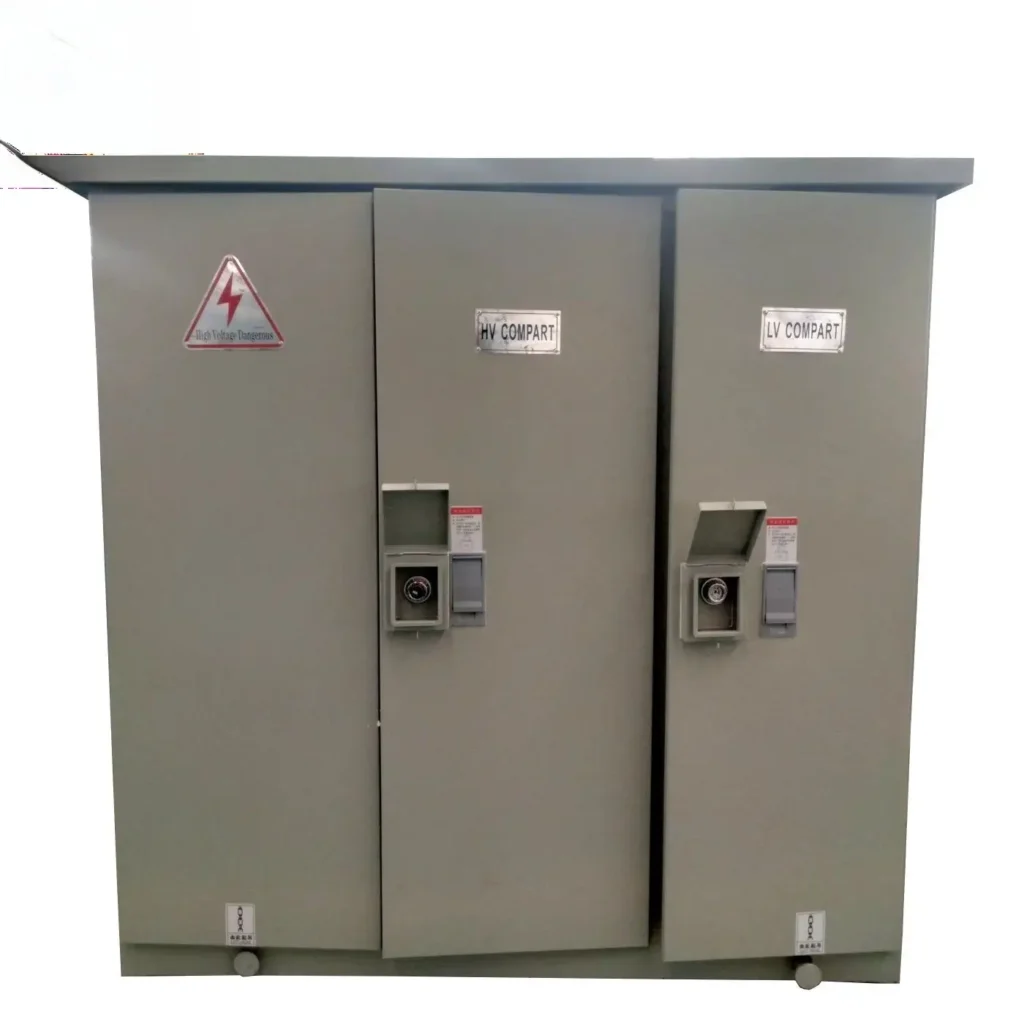
Ⅲ. Special Structural Design
1. Safety Protection
①Impact Protection: Steel anti-collision beams (impact energy ≥ 20J) are installed around the cabin, suitable for high-traffic environments such as urban roads and residential areas.
②Interlocking Protection: The high-voltage cabinet door is mechanically interlocked with the transformer compartment door, and the low-voltage cabinet door is electrically interlocked with the circuit breaker to prevent accidental operation under power.
③Grounding Design: The cabin and equipment casing are dual-grounded, with a grounding resistance of ≤4Ω, in compliance with GB 50169 (Specifications for the Construction and Acceptance of Grounding Devices).
2. Environmental Adaptability
①entilation and Cooling: Natural ventilation (louvers + insect screens) is primarily used. An IP55-rated forced fan is optional for high-temperature regions to ensure the cabin temperature is ≤40°C.
②Humidity Control: An optional dehumidifier/heater maintains the cabin humidity ≤60% RH to prevent condensation from affecting insulation.
③Noise Reduction: Sound-absorbing cotton is installed on the inner walls of the transformer compartment. Combined with a low-noise transformer, the noise level is ≤50dB (at a distance of 1 meter), making it suitable for residential areas and areas near schools.
3. Intelligent Expansion
①A pre-installed intelligent monitoring interface supports Modbus and IEC 61850 communication protocols and can be connected to the power distribution automation system for remote temperature and pressure measurement and fault alarms.
②A removable cover is provided at the bottom of the cable trench, with 2-4 spare cable outlets reserved for future load expansion.
IV. Transportation and Installation Structure
1.Lifting Design: Four lifting lugs are installed on the top, with a load capacity of ≥ 1.5 times the cabin weight, in compliance with GB/T 3811 (Crane Design Specifications).
2.Foundation Requirements: Concrete platform thickness ≥ 200mm, levelness ≤ 3mm/m, with pre-buried anchor bolts (in compliance with GB/T 799 (Anchor Bolts)), eliminating the need for complex civil engineering.
3.Joint Design: Sub-modules are connected using flanges with EPDM sealing strips (in compliance with GB/T 18173), achieving an IP54 waterproof rating. On-site splicing requires only bolt tightening, making it convenient and efficient.
Specification
Prefabricated Substation(Chinese style box)
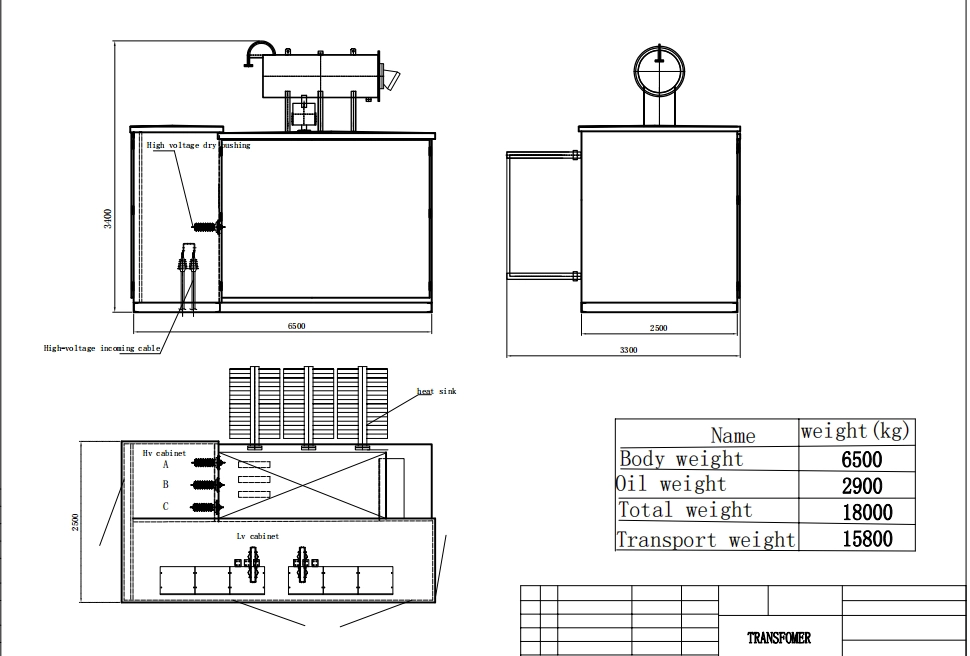
| Capacity (kVA) | A | B | C | D | E | F | H |
|---|---|---|---|---|---|---|---|
| 100-250 | 1900 | 1650 | 1250 | 650/800 | 600 | 1410/1560 | 1450 |
| 315 | 1900 | 1650 | 1350 | 650/800 | 650 | 1460/1610 | 1450 |
| 400-500 | 1900 | 1750 | 1450 | 650/800 | 650 | 1490/1640 | 1550 |
| 630 | 1900 | 1750 | 1550 | 650/800 | 700 | 1580/1730 | 1550 |
| 800 | 1900 | 1850 | 1550 | 650/800 | 700 | 1640/1790 | 1650 |
| 1000 | 1900 | 1850 | 1650 | 650/800 | 700 | 1640/1790 | 1650 |
FAQS
Prefabricated Substation(Chinese Style Box)FQAS
When purchasing a Prefabricated Substation(Chinese Style Box), you may want to know the following questions & answers.
Ⅰ.Basic Concepts
1. What is a Chinese-style substation?
A Chinese-style substation is a prefabricated power distribution system designed specifically for the Chinese market. It integrates national standard configurations, Chinese landscape elements, and modular technology. It conforms to domestic grid operation and maintenance practices while coexisting harmoniously with urban and rural environments, making it suitable for a variety of power distribution scenarios in China.
2. How does it differ from American-style and European-style substations?
Chinese-style substations are based on national standards (such as GB/T 17467), with components adapted to domestic operation and maintenance tools. Their exteriors can incorporate Chinese elements and emphasize aesthetic appeal. American-style substations emphasize North American standards (ANSI/IEEE) and compact designs, while European-style substations focus on air insulation and stainless steel. The three differ in standards, structure, and exterior design.
Ⅱ. Technical Parameters
3. What are the standard voltage and capacity ranges?
High voltage: 6kV/10kV/35kV (domestic mainstream), low voltage: 0.4kV, capacity: 30kVA-8000kVA; custom voltages and capacities are available to meet diverse needs.
4. What are the protection and corrosion resistance capabilities?
Basic protection: IP54, upgradeable to IP65. The standard version is made of galvanized steel plate, with a salt spray test of ≥500 hours. For coastal areas/chemical zones, 304 stainless steel with salt spray coating is optional, with a corrosion resistance of ≥20 years.
Ⅲ. Installation and Commissioning
5. What are the installation foundation requirements?
A concrete platform (thickness ≥200mm, levelness ≤3mm/m) is required, with pre-buried anchor bolts, a reserved cable trench (width ≥600mm), and a grounding resistance of ≤4Ω.
6. Is on-site splicing required? Are there any transportation restrictions? A: Small-capacity units are integrated (length ≤ 12m, suitable for road transport), while large-capacity units are compartmented (modules assembled and bolted on-site). They must be secured on a dedicated pallet during transportation to prevent severe vibration.
Small-capacity unitsare integrated (length ≤ 12m, suitable for road transport), while large-capacity units are compartmented (modules assembled and bolted on-site). They must be secured on a dedicated pallet during transportation to prevent severe vibration.
Ⅳ.Operation, Maintenance, and Safety
7. What daily maintenance is required?
Monthly inspection of the compartment seal, oil level (oil transformer), and vents; annual infrared temperature measurement (busbar connection points), ground resistance test, and protective device calibration.
8. How to cope with high or low temperature environments?
In high-temperature areas, forced air cooling is optional (automatic start at ≥85°C); in low-temperature areas, the oil transformer is equipped with -25°C anti-condensation oil, and a heater is installed inside the compartment to prevent condensation.
Ⅴ.Selection and Customization
9. How to select a model based on the project?
For residential areas, choose the “Landscape Compact + Low Noise” model (capacity 30-1600kVA); for industrial parks, choose the “Large Capacity Durable Model” (1000-8000kVA); for new energy projects, choose the “Grid-Connected Model” (with reserved photovoltaic/wind power connections).
10. Does it support renewable energy integration?
Yes. We can customize grid-connected protection devices (compliant with GB/T 19964, the national standard for photovoltaic grid connection) and bidirectional electricity meters to meet the grid connection requirements of photovoltaic and wind power projects.
Ⅵ.Common Troubleshooting
11. What should I do if the transformer overheats?
First, check whether the cooling fan is running and the oil level is normal (for oil-fired transformers). Then, confirm whether the load exceeds the limit. If the problem persists, contact a technician to check the winding insulation.
12. The high-voltage switchgear cannot be closed?
Check whether the mechanical interlock (the high-voltage switchgear and transformer door are interlocked) has been reset and whether the cable connectors are properly plugged in. Ensure there is no risk of improper operation under power, then try again.
Other Questions
Ⅶ.Other Questions
13. What is the warranty period? What is the after-sales service like?
The entire unit has a 12-month warranty, and the transformer itself is extended to 2 years. We provide 24/7 technical support, with a fault response time of ≤ 2 hours. We also provide free component replacement and on-site repairs during the warranty period.
14. What are some domestic application cases?
Typical cases include the renovation of old residential communities in a provincial capital city, a photovoltaic power station grid-connected project, and a power distribution project in an industrial park. Project photos and operation reports can be provided for reference.
Why Choose us ?
Built to last, engineered to perform.
Kete Transformer is a key national-level manufacturer specializing in transformers, recognized as a “Contract-Honoring and Promise-Keeping” enterprise, a high-tech enterprise, and a national-level enterprise technology center. It is recommended in the national directory for rural and urban power grid construction and renovation, as well as a recommended supplier of major electromechanical equipment for hydropower projects. Its products have been awarded the title of “National Quality Inspection Qualified Product – Quality Trustworthy Product” and “Nationally Recognized Product for Mechanical Industry Users.
Our Project
Our products not only dominate the domestic market but are also exported to more than 30 countries and regions, including Russia, Southeast Asia, Africa, and the Americas, serving industries such as power, municipal engineering, metallurgy, and petrochemicals.